
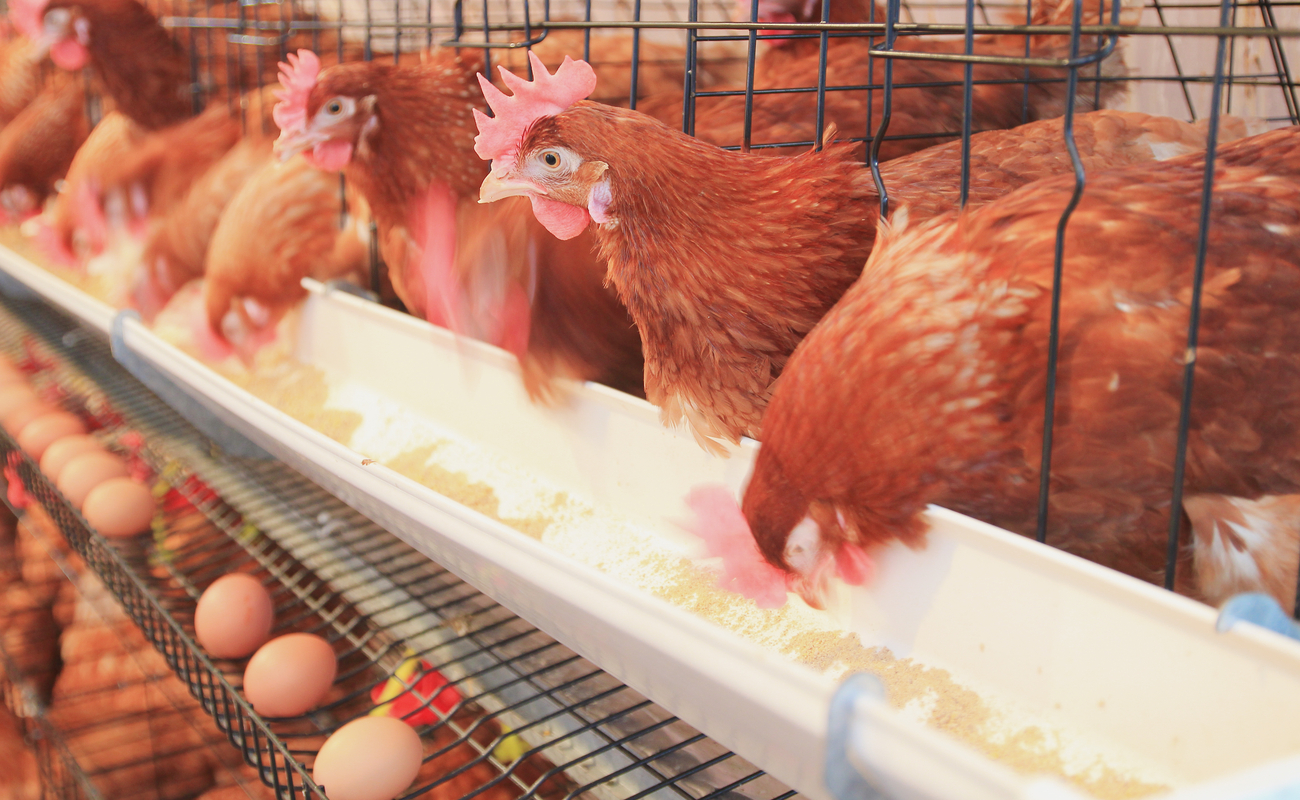
©Shutterstock Chicken hens eggs in farm.
Before I even proceed with writing the article, let me explain what a layer poultry farm is. A layer poultry farm is the type of farm that raises chicken solely for the purpose of producing eggs although occasionally, the birds are sold off as meat as they near the end of their laying period.
Now, calculating the profit or loss of a layer farm is not as easy as it seems. For a normal merchandising enterprise, you have two forms of expenses i.e. cost of goods sold and operational expenses. For instance, if you are running a boutique your expenses include the cost price of the clothes you are selling and the operating expenses associated with selling the clothes such as rent, workers’ wages, and utilities.
To continue with my example, let’s assume in the month of July 2020, you sold 20 clothes for GH¢ 100 each, here is how your profit is going to look like assuming the cost price for the clothes are GH¢ 50 each, storekeeper’s salary is GH¢ 500, rent is GH¢ 200 and utility expense is GH¢ 150.
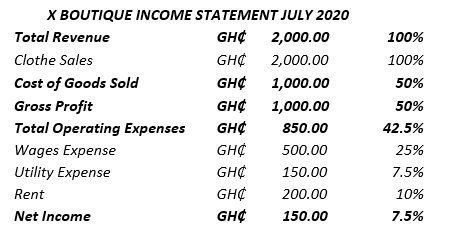
As you can see from the table above, the net income or profit for the month of July is GH¢150.
So we were able to determine the profit for our hypothetical boutique here but wait a minute. Aren’t we rearing layers? If we are rearing layers, how then do we determine the cost of goods sold since we don’t purchase our eggs directly from suppliers but rather, it is the hens that lay the eggs?
Calculating the profit made in a particular period, say August 2020 is not as simple as calculating that of a merchandising business. Let’s assume we rear 1,000 birds; during the course of August, we sold GH¢ 11,000 worth of eggs and 200 spent layers for GH¢ 4,000 taking our total revenue for the month to GH¢ 13,400.
Now I know what you might be thinking, “Is Papa Kwame serious, so he cannot do a simple addition of GH¢ 11,000 and GH¢ 4,000 to get GH¢ 15,000?” Chill out, I know what I’m doing. You see, what I haven’t yet told you is that the cost of a day-old chick for each spent layer sold is GH¢ 8 so we multiply that by 200 and subtract from GH¢ 4,000 leaving us with GH¢ 2,400. After that, we add the GH¢ 2,400 to GH¢ 11,000 to make GH¢ 13,400. I am going to explain why we subtracted the cost of the day-old chicks very soon so please stick around.
So now let’s talk about the expenses. Let’s assume in the month of August, we spent GH¢ 1,000 on wages, GH¢ 200 on utilities, GH¢ 5,000 on feed, GH¢ 150 on supplies, GH¢ 250 on fuel, GH¢ 100 on drugs, and GH¢ 1,000 on miscellaneous expenses.
Putting everything together this would be our income statement for August 2020.
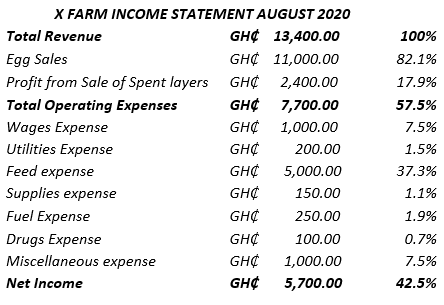
From the table above, you can see that the net income or profit for the period of August is GH¢ 5,700 which is calculated by subtracting total expenses of GH¢ 7,700 from the total revenue of GH¢ 13,400.
You remember earlier in the article, even though we sold 200 spent layers for GH¢ 20 each, I recorded the revenue for that transaction as GH¢ 2,400 instead of GH¢ 4,000. The reason why I did this was that the layers are assets since they were purchased as day-old chicks purposely to mature and lay eggs. Therefore, in the event we sell any of them, we are merely transforming one asset (layers) into another asset (cash) which is termed liquidation. So we only record revenue with respect to the spent layers when we sell them in excess of the price of which we purchased them as day-old chicks which in this case is GH¢ 2,400.
Finally, Feed expense is not the amount of feed you purchase in a particular period but rather the amount of feed the birds consume. For instance, in our example, we might have purchased 60 bags of layer mash at the beginning of the month but at the end of August, only 6 bags of feed were left. This means the birds consumed 54 bags of feed within that period hence we end up with a feed expense of GH¢ 5,000 assuming each bag costs GH¢ 93.
In conclusion, calculating the profit for a layer operation is not as easy as it sounds so I hope this article has been informative enough to guide you on how to make such a calculation.
If reading this article piques your interest in starting your poultry venture, it will be in your best interest to write a good business plan. Even if you don’t necessarily have the time to write your own, don’t worry. Just send us a WhatsApp message by following this link https://wa.me/233592239127. And we’ll draft a professional business plan for you at a very reasonable price.
Are you tired of too much paperwork involved in keeping records on feed, egg collection, vaccination, mortality, profit, and loss, etc.? Worry no more. We are developing a software application that simplifies poultry management. Follow this link if you are interested.
Finally, are you ready to start your dream poultry farm, but don’t know how to construct the chicken house, brood the chicks, source the right materials, etc.? Just follow this link https://wa.me/233592239127 for more inquiries.
 Pkom
Pkom 