
Pig farming has become a very lucrative business venture in Ghana due to the increasing demand for pig products. Hence, the need to produce more pigs has become increasingly necessary. In any business venture, the entrepreneur aims to make a profit. Therefore, if you’re to venture into this so-called “lucrative” business, you need to know how much profit you are likely to make. In our previous article, we discuss how much money you need to start pig farming. In this article, we’re going to look at how much profit you could potentially make from pig farming based on the number of pigs we used in that article.
To start pig farming, you need certain assets such as land, structure, parent stock, a well, water tank amongst others. These assets are long term assets that you purchase once and for all and will occasionally require maintenance which may cost some money. But for this article, we are only going to consider the operational expenses since we believe that you must have acquired all these assets before you even start rearing the pigs.
The operational expenses consist of the cost of all the husbandry practices such as feeding, deworming, iron injection, cleaning of the sty and what have you. In other words, it encapsulates all the expenses you incur from when the piglets are born, weaned till the time they are sold. Calculating the profit becomes easy enough if we know the total amount it cost us to raise the pigs. All we need to do now is to subtract it from the revenue generated from the sale of the pigs and then we have our profit.
Since we need to know the amount of the operational expenses to calculate the profit, we are going to break down the step by step cost of how much it costs to raise the pigs right from the time they are born to the time they are sold. Like I mentioned earlier, we are going to calculate the profit based on the number of pigs we used in the previous article which was four sows and a boar.
We are going to purchase 4 sows and a boar when they are four months old and mate them when they are six months old. The gestation period for pigs is 3 months, 3 weeks and 3 days but for our purposes, we’ll simply round it to four months. Our expenses for these 5 parent stock are going to be calculated for 6 months, that is, 2 months before the get pregnant and 4 months when they are pregnant.
The pigs need to be dewormed once every month and the cost of deworming is GH₵5.00 per pig per month. This takes the cost of deworming 5 pigs for 6 months up to GH₵150.00. You need to hire a farmhand to clean the sty and see to the day to day operation of the farm. Paying the farmhand GH₵500.00 for 6 months takes the salary cost to GH₵ 3,000.00. Calculating the feed cost is a bit tricky here as the pigs tend to consume different quantities of food at certain stages in their growth. To make it simple enough, we are going to use an average figure of 3kg of feed per day. The average cost of a 50kg feed is about GH₵100.00. This takes the feed cost to GH₵5,400.00. The total expenses for the parent stock for the period before they give birth is GH₵8,550.00.
We are now going to consider how much it will cost to raise the newborn piglets from the time they are born to the time they are sold which is 6 months. Lactating sows lactate for about 6 weeks after which the piglets are weaned. They will therefore require more feed to produce quality and nutritious breast milk for the piglets. Newborn piglets require iron supplement as well as the monthly deworming. Sows give birth to an average of 10 piglets per litter, therefore, the 4 sows are expected to give us 40 piglets.
Deworming 45 pigs for 6 months at a cost of GH₵ 5.00 amounts to GH₵1,350.00. The 40 newborn piglets will require iron injection which also cost GH₵5.00 taking the total iron injection cost to GH₵200.00. The total salary cost for the farmhand will amount to GH₵3,000.00. For the feeding expenses, we are going to calculate separately for the parent stock and the other pigs. Lactating sows consume an average of 5kg per day and they lactate for approximately 2 months. For simplification, let us add the parent boar to the lactating sows. This takes the feeding cost for the first 2 months for the parent stock to GH₵3,000.00. For the remaining 4 months, they’ll consume an average of 3kg per day and this takes the feeding cost to GH₵3,600.00. The total cost of feeding the parent stock is GH₵6,600.00. The 40 newborn pigs consume an average of 2kg of feed from the time they are born to the time they reach a slaughter weight of about 60kg in 6 months. Therefore, the total cost of feeding them amounts to GH₵ 28,800.00. The total cost of the expenses after the parent pigs give birth till the time they (the new pigs) mature to slaughter weight is GH₵ 39,950.00.
Apart from the main expenses such as feed costs, veterinary services and labour, there are some other minor expenses that I’m going to group as miscellaneous. For example, teeth clipping is the removal of some of the teeth of the newborn piglets which can be harmful to the lactating sow during breastfeeding or they can harm each other with their teeth if not removed or broken. Another one is tagging or tattooing the pigs to keep track of them and aid in record keeping. These practices come with a cost. There are other costs such as transportation costs, marketing cost, slaughtering cost, bookkeeping cost, etc. which will need to be catered for. I am therefore going to group all of these costs under miscellaneous costs and make it 10% of our total basic operational cost.
The sum of the expenditure for the first 6 months and the second 6 months is GH₵48,500.00. Miscellaneous cost is 10% of the basic cost which is GH₵4,850.00. This amounts to GH₵53,350.00 in total. Like was aforementioned in this article, calculating the profit requires that we know the total amount of expenditure and the cost of selling the pigs. All we need to do now is to wave some mathematical magic and find our profit. Or perhaps we could just calculate the total cost of selling the 40 pigs and subtract the total expenditure from it.
Pigs are sold per the weight of their meat. A pound of pork costs about GH₵12.00 and since 2.2 pounds will make a kilo, a kilo of pork will cost slightly above GH₵25.00. A mature pig weighs about 60 kilos so its market price will be about GH₵1,500.00. Selling the 40 pigs will give us a total revenue of GH₵60,000.00. The profit is, therefore, GH₵6,650.00 which is 11.08% of the total revenue.
The table below represents an income statement which summarizes the total revenue and expenses which have been described so far concerning our pig farm.
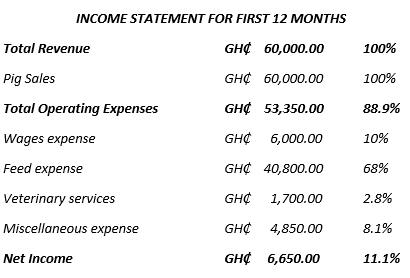
From the table above, it can be concluded that you could make a profit of GH₵ 6,650.00 in 12 months just by starting with a breeding stock of 4 sows and 1 boar. In 12 months, revenue for 40 pigs would amount to GH₵ 60,000 which means if we manage to sell a mature pig for more than GH₵ 1,500.00 each, we stand to make more profit. Furthermore, the feed estimates used in this article were derived from the prices of commercially prepared feed. You also stand to maximize your profit potential if you manage to mix your own feed.
 Pkom
Pkom 
That’s hood
LikeLike
Great job, my name is Michael and I have been trying to go into pig farming but just trying to get the capital for that. What I have read so far about your explanation tells me how good it is thank u for shearing your ideas.
LikeLike