
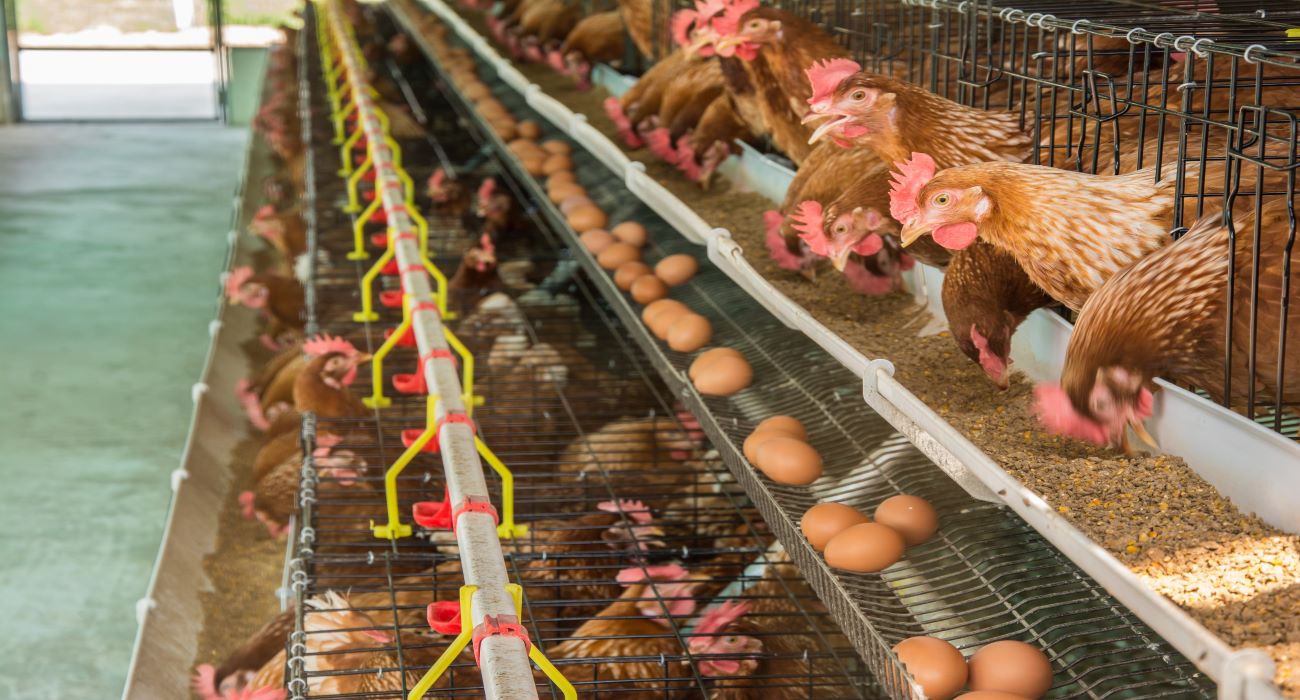
©Shutterstock Hen house business in Thailand.
On the 3rd of May, 2021, someone posted on a Facebook group about the need for poultry farmers to form a unified front when it comes to setting egg prices. As good as his intentions may sound, Ghana operates a free market system, and therefore, entrepreneurs can set prices for their goods for as low or as high as they deem fit.
Assuming you want to start a poultry farm of 1000 layers, you should expect your operating expenses to be around GH₵ 11,000 monthly on average after your birds begin to lay eggs. Given this, assuming each bird lays 5 eggs in a week, you should sell a crate of 30 eggs for at least GH₵ 16.5 to break even.
The problem with many poultry farmers in Ghana is that they expect a ready market for their produce with minimal stress. For instance, when they produce 667 crates of eggs they expect a buyer to knock on their door and provide them with bulk cash.
Now this isn’t such a huge problem when there are fewer suppliers (farmers), and prices of raw materials such as feed remain stable but in the current situation we find ourselves in, many small scale farmers keep reducing the prices of their eggs even though the cost of poultry production keeps going up. Later, they find themselves going out of business. Why do they suffer from this? Because they are targeting the wrong customers.
You see, when you are running a relatively large operation (5000+ birds), the cost of production per egg reduces. You know why? Because larger farms can get huge discounts on feed purchases, and also, they have enough capital to invest in automation hence may eliminate the need to hire more labourers. So for these folks, their cost of producing the same 1000 layers after they begin laying could be around GH₵ 9,000. Now at GH₵ 9,000 production cost, such a farmer can sell one crate of 30 eggs for as low as GH₵ 14 and still make a profit – and by GH₵ 14, I mean jumbo-sized eggs.
So what then is the solution for farmers who run smaller operations? You need to start targeting consumers directly. This means instead of accumulating several crates of eggs over a week or two just to sell to a middleman for a slim or sometimes zero profit margin, you need to go directly to the consumer market where you can sell your eggs for much higher prices.
To further elaborate, I recently visited Shoprite, the Takoradi Mall branch and found that a crate of six “Eden” eggs was priced at GH₵ 6.49. This means if you had 1000 layers, you could be making more than GH₵ 21,600 in revenue if you sell your eggs at the same price Shoprite sells their crate of six eggs.
Sure, you don’t even need to sell your eggs for a high as what Shoprite does. You can price your eggs as follows 6-egg-crate: GH₵ 6, 12-egg-crate: GH₵ 10, 30-egg-crate: GH₵ 20. Now assuming 40% of the total egg sales came from 6-egg-crates, 25% from 12-egg-crates and 35% from 30-egg-crates, this means if you have 1000 birds, you actually make more than GH₵ 16,800 in revenue. Do you remember we said earlier that you could spend as much as GH₵ 11,000 if you rear 1000 birds? Well, add an extra GH₵ 1,000 for extensive marketing, and the total expenses amount to GH₵ 12,000 – you are still going to make at least GH₵ 4,800 profit.
So you see, taking a close look at marketing could well be the difference between success and failure. To leverage the internet for more sales, it is imperative to open accounts or pages for your farm on some of the most popular social media outlets such as Facebook and Instagram.
After building your social media accounts, you can start marketing your eggs. To reach a wider audience, you may have to invest some money in social media ads. If you handle your social media marketing well, you should see a return on your money spent on ads.
To conclude, there is still a high demand for eggs in Ghana. Despite this, some farmers still find it hard to find buyers because they are not putting enough effort into marketing their products. I believe there is so much untapped potential when it comes to generating wealth online so instead of farmers always relying on middlemen, I implore them to put in the extra effort to at least open a Facebook page. A simple decision such as this could help your target the right customers, make larger profits, and more importantly, stay in business.
You may be interested in a more detailed analysis of potential revenues and expenses when starting a poultry farm but this article can only permit me to discuss so much. Feel free to contact us for your professionally drafted business plan on poultry farming for a more detailed analysis on operations, marketing and financials.
 Pkom
Pkom 