How to Raise Money to Start a Pig Farm

Let’s face it, starting a pig farm requires a lot of capital but if we want to do business, we probably do it because we want to make a lot of money. So why then do we have to spend as much as GH¢ 100,000 over a year to raise around 45 pigs if we intended to make money in the first place. Don’t you think that would be counterintuitive? Sure, not necessarily everyone is starting a pig farm because they want to make a lot of money – some people are already pretty rich but they are only considering pig farming as a way to diversify their investment portfolio.

Granted pig farming is capital intensive, we still cannot ignore its immense profit potential. For instance, if we manage to sell 40 pigs as stated in a previous article in our first year we stand the chance of making GH₵ 6,650 profit – this doesn’t sound like much but remember that the estimate for the sale of a single pig we used was GH₵ 12 per pound. Now if we manage to sell our pigs for GH₵ 15 per pound and increase the number of pigs sold to 50 in year 2, we stand the chance of making around GH₵ 23,312.50 in profit. Assuming we maintain the same number of pigs sold for three more years and also, our expenses remain the same, we get to make GH¢ 69,937.50 in additional profit.

Judging from our estimates you can see that we are projecting a combined profit for the first five years at GH¢ 99,900.00.

Since we have established that we can make a profit of almost GH¢ 100,000.00 in 5 years, can we now celebrate? No! Let’s not be overexcited yet. Remember, we need to invest GH¢ 100,000 to achieve all this. 

So now you may be asking, “how can I raise all this money?” Well, this is where you need to be a little creative. Below, we highlight some strategies through which you can raise the needed capital for your pig farm.

  1. Look for business partners: It would be very difficult if not impossible for an individual to raise GH¢ 100,000.00 on his own but when groups of 3 or 4 people put their heads together and decide to start this particular venture, things become much bearable for each partner. For instance, if 4 individuals decide to split the startup capital equally, each person would have to contribute GH¢ 25,000 which is well within the reach of most well-paid workers such as doctors, lawyers, engineers and to some extent, teachers in Ghana.
  2. Raise funds on your own: Usually, this point should be number one because, of course, whenever you want to start a business, you should strive to first run it with your own money before you set out for others. However, the startup capital involved with this kind of farm is such that it would be more favourable to enter a partnership. Partnerships are not without their problems, however. There could easily be disagreements or friction among partners. To avoid any potential disagreements, you may have to be very patient if you want to go solo. For instance, if you earn GH¢ 2,000 a month and you save GH¢ 500 out of that, it will take you more than 16 years to raise capital to start a pig farm that will sell 40 pigs in a year. Now, instead of waiting for 16 years, you could rather start with 1 sow and 1 boar so that you may produce 10 pigs for sale within a year – this kind of farm would probably require GH¢ 30,000 to start. This new starting capital could be raised by you in 5 years instead of you trying to wait for 16 years. You may even cut the time needed to raise this new capital to 2 and a half years if you save GH¢ 1,000 of your monthly income instead of GH¢ 500. In short, if you are going to raise money on your own, start with a smaller number of pigs and gradually expand your farm as the years go by. 
  3. Go for a bank loan: You remember in the previous point, we mentioned that it would take you five years to raise GH¢ 30,000 if you saved GH¢ 500 per month. Now, instead of waiting for 5 years to raise GH¢ 30,000 you can go straight to the bank and take the amount upfront and pay them GH¢ 500 per month until the loan’s principal is repaid. Sounds good right, you don’t have to wait for 5 years to raise the capital but aren’t we forgetting something? The issue is loans are not for free. Assuming the bank charges 20% interest per annum, you’ll be obligated to pay GH¢ 6,000 per year in addition to the principal meaning at the end of the 5 years, you would have paid GH¢ 60,000 in total to the bank. Now compared to raising the money on your own, you get to receive ready cash when you get a bank loan but notice that you would have to pay double the startup capital to the bank in 5 years.
  4. Look for investors: There are many wealthy individuals around who are looking to invest some of their money into promising ventures. Since pork is one of the top protein sources consumed by millions of people, pig farming is a very lucrative venture and more and more people are becoming aware of this. If you manage to draft a very professional business plan you can start pitching your idea to potential investors, however, count yourself lucky if you send proposals to a hundred people and only five of them show any interest. If you plan on seeking investment, keep in mind that you are going to face many rejections so don’t give up. 

Conclusion

Depending on whether you are going to receive external capital or not should influence your decision on how big you should start your farm. From the article, it is very advisable that if you want to start a relatively big operation, you should look for partners who can share the startup capital burden with you. However, if you don’t happen to find any investors or are not interested in dealing with partners, you should aim to start as small as possible but expand gradually as the years go by.
How Much Profit Can You Make From a Pig Farm?

Pig farming has become a very lucrative business venture in Ghana due to the increasing demand for pig products. Hence, the need to produce more pigs has become increasingly necessary. In any business venture, the entrepreneur aims to make a profit. Therefore, if you’re to venture into this so-called “lucrative” business, you need to know how much profit you are likely to make. In our previous article, we discuss how much money you need to start pig farming. In this article, we’re going to look at how much profit you could potentially make from pig farming based on the number of pigs we used in that article.

To start pig farming, you need certain assets such as land, structure, parent stock, a well, water tank amongst others. These assets are long term assets that you purchase once and for all and will occasionally require maintenance which may cost some money. But for this article, we are only going to consider the operational expenses since we believe that you must have acquired all these assets before you even start rearing the pigs.

The operational expenses consist of the cost of all the husbandry practices such as feeding, deworming, iron injection, cleaning of the sty and what have you. In other words, it encapsulates all the expenses you incur from when the piglets are born, weaned till the time they are sold. Calculating the profit becomes easy enough if we know the total amount it cost us to raise the pigs. All we need to do now is to subtract it from the revenue generated from the sale of the pigs and then we have our profit.

Since we need to know the amount of the operational expenses to calculate the profit, we are going to break down the step by step cost of how much it costs to raise the pigs right from the time they are born to the time they are sold. Like I mentioned earlier, we are going to calculate the profit based on the number of pigs we used in the previous article which was four sows and a boar.

We are going to purchase 4 sows and a boar when they are four months old and mate them when they are six months old. The gestation period for pigs is 3 months, 3 weeks and 3 days but for our purposes, we’ll simply round it to four months. Our expenses for these 5 parent stock are going to be calculated for 6 months, that is, 2 months before the get pregnant and 4 months when they are pregnant.

The pigs need to be dewormed once every month and the cost of deworming is GH₵5.00 per pig per month. This takes the cost of deworming 5 pigs for 6 months up to GH₵150.00. You need to hire a farmhand to clean the sty and see to the day to day operation of the farm. Paying the farmhand GH₵500.00 for 6 months takes the salary cost to GH₵ 3,000.00. Calculating the feed cost is a bit tricky here as the pigs tend to consume different quantities of food at certain stages in their growth. To make it simple enough, we are going to use an average figure of 3kg of feed per day. The average cost of a 50kg feed is about GH₵100.00. This takes the feed cost to GH₵5,400.00. The total expenses for the parent stock for the period before they give birth is GH₵8,550.00.

We are now going to consider how much it will cost to raise the newborn piglets from the time they are born to the time they are sold which is 6 months. Lactating sows lactate for about 6 weeks after which the piglets are weaned. They will therefore require more feed to produce quality and nutritious breast milk for the piglets. Newborn piglets require iron supplement as well as the monthly deworming. Sows give birth to an average of 10 piglets per litter, therefore, the 4 sows are expected to give us 40 piglets.

Deworming 45 pigs for 6 months at a cost of GH₵ 5.00 amounts to GH₵1,350.00. The 40 newborn piglets will require iron injection which also cost GH₵5.00 taking the total iron injection cost to GH₵200.00. The total salary cost for the farmhand will amount to GH₵3,000.00. For the feeding expenses, we are going to calculate separately for the parent stock and the other pigs. Lactating sows consume an average of 5kg per day and they lactate for approximately 2 months. For simplification, let us add the parent boar to the lactating sows. This takes the feeding cost for the first 2 months for the parent stock to GH₵3,000.00. For the remaining 4 months, they’ll consume an average of 3kg per day and this takes the feeding cost to GH₵3,600.00. The total cost of feeding the parent stock is GH₵6,600.00. The 40 newborn pigs consume an average of 2kg of feed from the time they are born to the time they reach a slaughter weight of about 60kg in 6 months. Therefore, the total cost of feeding them amounts to GH₵ 28,800.00. The total cost of the expenses after the parent pigs give birth till the time they (the new pigs) mature to slaughter weight is GH₵ 39,950.00.

Apart from the main expenses such as feed costs, veterinary services and labour, there are some other minor expenses that I’m going to group as miscellaneous. For example, teeth clipping is the removal of some of the teeth of the newborn piglets which can be harmful to the lactating sow during breastfeeding or they can harm each other with their teeth if not removed or broken. Another one is tagging or tattooing the pigs to keep track of them and aid in record keeping. These practices come with a cost. There are other costs such as transportation costs, marketing cost, slaughtering cost, bookkeeping cost, etc. which will need to be catered for. I am therefore going to group all of these costs under miscellaneous costs and make it 10% of our total basic operational cost.

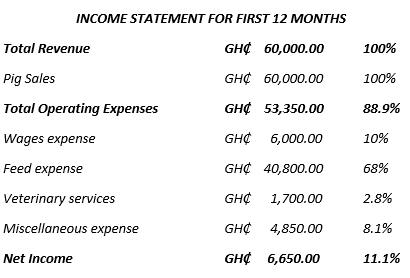
The sum of the expenditure for the first 6 months and the second 6 months is GH₵48,500.00. Miscellaneous cost is 10% of the basic cost which is GH₵4,850.00. This amounts to GH₵53,350.00 in total. Like was aforementioned in this article, calculating the profit requires that we know the total amount of expenditure and the cost of selling the pigs. All we need to do now is to wave some mathematical magic and find our profit. Or perhaps we could just calculate the total cost of selling the 40 pigs and subtract the total expenditure from it.

Pigs are sold per the weight of their meat. A pound of pork costs about GH₵12.00 and since 2.2 pounds will make a kilo, a kilo of pork will cost slightly above GH₵25.00. A mature pig weighs about 60 kilos so its market price will be about GH₵1,500.00. Selling the 40 pigs will give us a total revenue of GH₵60,000.00. The profit is, therefore, GH₵6,650.00 which is 11.08% of the total revenue.

The table below represents an income statement which summarizes the total revenue and expenses which have been described so far concerning our pig farm.

From the table above, it can be concluded that you could make a profit of GH₵ 6,650.00 in 12 months just by starting with a breeding stock of 4 sows and 1 boar. In 12 months, revenue for 40 pigs would amount to GH₵ 60,000 which means if we manage to sell a mature pig for more than GH₵ 1,500.00 each, we stand to make more profit. Furthermore, the feed estimates used in this article were derived from the prices of commercially prepared feed. You also stand to maximize your profit potential if you manage to mix your own feed.

Putting Up a Structure for a Pig Farm: What You Need to Know.

©Shutterstock Pig and piglets in breeding pig farm.

It is true that pigs have a very high disease resistance and can virtually feed on any kind of feed you give them. However, if you are going to rear pigs on a commercial scale, you will need to maximize profit and productivity and to achieve that, you need to ensure that they are properly sheltered.

Over the last couple of years, the popularity of pig farming has increased greatly in Ghana and Africa at large. This is because pig products like bacon, pork and sausages have been in high demand. I spoke about some things you need to know before you start a pig farm in a previous article but on this occasion, I’m going to focus on the things you need to consider when building a housing unit for the pigs.

Pigs are very strong animals and therefore you must provide a very strong and durable structure to house them. Thus, you need to ensure that the materials which will be used for the construction of the pigsty are very strong. Using weak wood isn’t advisable because the pigs may gradually chew off the wood. Even after building their sty, you will have to get the inside plastered because they may chew off the bricks as well. As a farmer, you must avoid cutting corners when it comes to constructing their sty or else, you may end up with a dilapidated sty after only after a few years.

Designing the sty may not be as simple as it may look. Yes, pigs do not need any sophisticated pen designs but careful planning and considerations have to be made before designing the pen. Pigs are social animals and therefore you can keep a number of them in one room as long as they are not overcrowded. The breed of the pigs which is going to be reared and the maturity level to which they are going to be kept will determine the size of the rooms in the sty. You need to design the sty to have rooms that will be appropriate for pregnant and lactating sows, grower pigs and boars. Similarly, the input of feed and output of animal waste must be considered carefully while designing pigsty. It is therefore recommended that there is an aisle in the middle of the sty with rooms on either side of the aisle. This will allow for the pigs to be transferred from one room to another easily for mating and allow the farmer to perform good husbandry practices with relative ease.

Pigs are very fatty animals hence they become very uncomfortable in high temperatures especially on hot sunny afternoons when the sun is scorching. The sty is usually not fully walled to the roof in order to allow for adequate ventilation and relatively cool temperature during the day. When constructing the sty, the position of the sunrise must be carefully considered so that the walls of the pen can cast a shade on the pigs when the sun is out. Raising the wall to about 3 to 4 feet is adequate enough. Wire mesh can be used to prevent animals such as snakes and rodents from entering the pigs’ abode. To ensure that the sty doesn’t get too hot during sunny days, metallic roofing sheets like the aluminium sheets shouldn’t be too close to the floor of the pen.

One of the most important nutrients for pigs is water. Pigs require water for a variety of reasons, including most metabolic functions, adjustment of body temperature, movement of nutrients into the body tissues, removal of metabolic waste, production of milk, and for growth and reproduction. A fully mature pig may consume about 10-15litres of water a day. Water is also needed for the cleaning of the sty. For this reason, the availability of water is very crucial when constructing a pigsty. If there isn’t any source of potable water in the area where your sty is located, then you may have to construct a well. When the pigs feel too hot, they sometimes lay in the water they are supposed to drink. Some pigs even urinate and defecate in their drinking water, therefore, using nipple drinkers, even though they can be expensive to install, are efficient in conserving water and preventing the water from getting polluted by the pigs.

Pigs often get themselves very dirty if their sty is not cleaned properly and regularly. When constructing a sty, a drainage system should be made to get rid of animal excreta in an appropriate place since you wouldn’t want the livestock authorities in your area to be on your shoulders for improper disposal of the waste. The floor of the sty should be sloped slightly to allow for urine and wastewater to drain away. Partly or fully slated floor pens are usually preferred because they are easier to keep clean. However, solid concrete floors may also be satisfactory if they are well-drained. You may need to construct a good gutter to carry the waste to the appropriate places because you wouldn’t want your pigs to contract diseases due to improper waste management practices. Pig faecal wastes can be used as fertilizers so constructing a proper channel to collect them is very much recommended.

In a nutshell, Pigs can be kept in a field where there is a shelter or they can be kept in a pigsty. Pigs should not be allowed to wander about free. There will be no control over what they eat or where they go and disease will spread. That is why it is recommended that they are housed properly if they are going to be reared in commercial quantities. Providing good accommodation for the pigs greatly increases the productivity of your pig farm and reduces the risk of diseases and injuries to the pigs.

How Long Does It Take For A Poultry Farm To Be Successful?

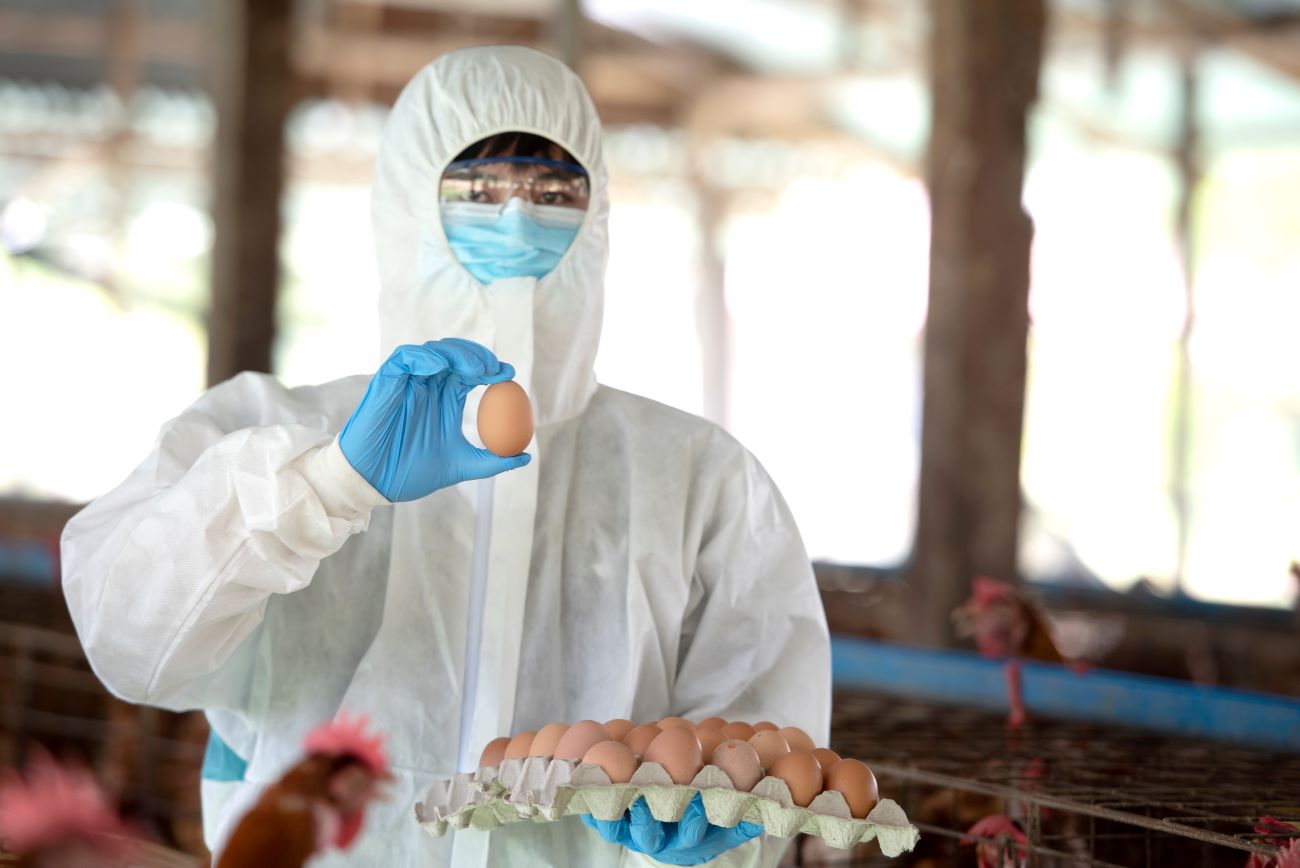
©Shutterstock Farmer checking chicken eggs.

In recent times, many people have discovered poultry farming as a golden ticket to prosperity. They get inspired to enter into the poultry farming business when they hear about names like Kwabena Darko, the founder of Darko Farms. The problem, however, is that many of them don’t realize that it may take years of hard work before any significant breakthrough can be made.

In any business, it is advisable to start small and grow it gradually and poultry farming is no exception. If you keep reading this article, you are going to discover a year-by-year breakdown of how long it will take for a poultry farm to be successful.

Year One

Starting a poultry farm from scratch will definitely involve some financial struggle. This is especially true if you want to rear layers. You would have to allocate money for some fixed assets such as land, structure for the birds, heating equipment, drinkers and day-old chicks. In addition to that, you would also have to spend money on operating expenses such as feed, utility, salary, etc. Since the layers do not start laying until after the 4th month, all these costs would have to be borne without getting any sniff of revenue for the first 4 months. Even when they start laying in the 5th month, usually only about 5% of the birds will lay and the sizes of their eggs wouldn’t be large enough to command the normal market price. The birds will only start laying at peak capacity from the 7th month onwards but they will be economically inviable to keep after approximately 18 months to 2 years so they would have to be sold off as spent layers.

Let’s assume you are starting the farm in January. Since you are starting with 500 birds, you are going to employ a growth strategy of getting 5000 birds by the 5th year. You would need to add 500 birds in the 5th and 9th months each in the first year to ensure that even when you sell the spent layers, you would still have hens laying at peak capacity. This will consequently increase the operational expenses so for the first year, a lot of investment would have to be put into the farm without any significant returns.

Year two

For the beginning of the second year, you would have about 1500 birds. At this point, our expenses would still be far more than the revenue you generate. But you are also pursuing a growth strategy so you would have to add another 750 birds in the first month, 5th month and 9th month. This will come with some fixed asset costs such as the expansion of structure and purchase of heating equipment and drinkers but you will not need to purchase any more land since you will be using the same old land. Operational expenses will definitely increase too. You would generate revenue from the sale of 1000 spent layers since 1000 of the total 1500 birds you added in the first year would have grown past peak laying capacity. Even though the farm at this point would be making a significant amount of revenue from egg sales, the expenses will still outweigh the income generated so you would need to invest more.

Year three

At the beginning of the third year, you would have 2750 birds in stock since you would have already sold 1000 of the birds as spent layers in the previous year. Just like you did in the previous years, you would stock the farm with day-old chicks in the 1st, 5th and 9th months, this time with 1000 day-old chicks each. In this year you would generate money from the sale of 2000 layers as they would have grown past peak laying capacity. In addition to that, you would also generate a significant amount of money from egg sales. Even with this, you would still need to invest money into the farm since the revenue generated wouldn’t be enough to cater for all the expenses. Mind you you added more chicks so you would definitely spend money on expanding the structure to accommodate these birds. The money you would have to invest in this year, however, would be significantly lesser than what you invested in the previous years.

Year four

In beginning the fourth year, you would have about 3750 birds in stock. You are going to add 1250 birds each in the 1st, 5th and 9th month each. Unlike you did in the previous years, you are not going to spend money on fixed assets such as structure, drinkers, heating equipment, etc. since the ones available would suffice for the accommodation of the birds. 2750 layers will grow past peak laying capacity in this year. The revenue you would generate from the sale of eggs plus the revenue you would generate from the sale of the 2750 spent layers would be enough to cater for all the operating expenses and the cost of the day-old chicks you would purchase to stock the pen in this year. This is the year you may not have to invest any more money into the farm as the proceeds would be able to cater for all the expenses. You are even likely to make a little profit in this year.

Year five

At the beginning of the fifth year, you would have 4750 birds in stock. You are going to add 1350 birds each in the 1st, 5th, and 9th months each like you did in the previous years. You would have achieved our growth target of 5000+ birds in this year. Just like in the previous years, you wouldn’t need to spend on fixed assets and you would be making enough revenue from the sale of spent layers and eggs to take care of the expenses. You are going to make profits without investing any money into the farm again since you wouldn’t be increasing the number of layers you stock the pen for a few years. In this year, you would definitely not recuperate all the money you have invested in the farm thus far. If you keep up with up with the good farm management and biosafety measures, it wouldn’t be too long until you have fully recuperated all of our investment into the farm.

Conclusion

Starting and maintaining a poultry farm can be very profitable but it isn’t easy. However, if you adhere to biosafety measures and farm management practices, you are very likely going to succeed. You may even recover all your investment after the third year if you decide to grow the farm very slowly or not grow at all. All you need is good planning and a proper financial understanding of the business you are undertaking.

Starting a Pig Farm: What You Need to Know

©Shutterstock Beautiful piglets at a farm.

If you’re looking for one of the most lucrative businesses under livestock production to invest in Ghana, then you should look no further than investing in commercial pig farming. This is because the demand for pork has skyrocketed in the past few years.

Pig products such as sausages and bacon, which can be quite expensive are also in very high demand in the urban areas in Ghana. Therefore, it is safe to say that commercial pig farming is a gold mine in the country at this moment hence you’re likely to gain huge profit if venture into this business.

Just like for every business venture, pig farming requires you to have a set business plan to prepare yourself adequately for the expenses ahead and the expected outcome. Consulting a professional is the best step towards this. With a business plan, you can get to source for capital from banks and other financial institutions and it will also serve as a benchmark for which your farm will be run.

Pig farming is sometimes considered a “dirty” job but the profits are mouthwatering. Therefore before you venture into the business, there are certain factors you should consider.

Suitable location

Firstly, you need to select a suitable location or land for your farm. The size of the land should be big enough to accommodate the structure and an expansion of the structure if you wish to grow the business. The land should be accessible to motorable roads and clean water. Also, the farm should be away from a residential area but close to market centers.

Selecting the right breed

Secondly, selecting the right breed of pigs to raise is very essential in maximizing profitability. There are a lot of pig breeds but they tend to have different production scale. Some of the most popular pig breeds in Ghana are Large White, Landrace, Yorkshires, Duroc, and Hampshire pigs. It is therefore very advisable to conduct thorough research about the pig before purchasing.

Some of the main features you should consider before selecting your breeding pigs are a pair of bright eyes, glossy coat, alertness and responsiveness to its surrounding environment, good temperament and good appeal to food, easy and normal movement and free from lameness or any other unnatural signs. Avoid purchasing aggressive pigs.

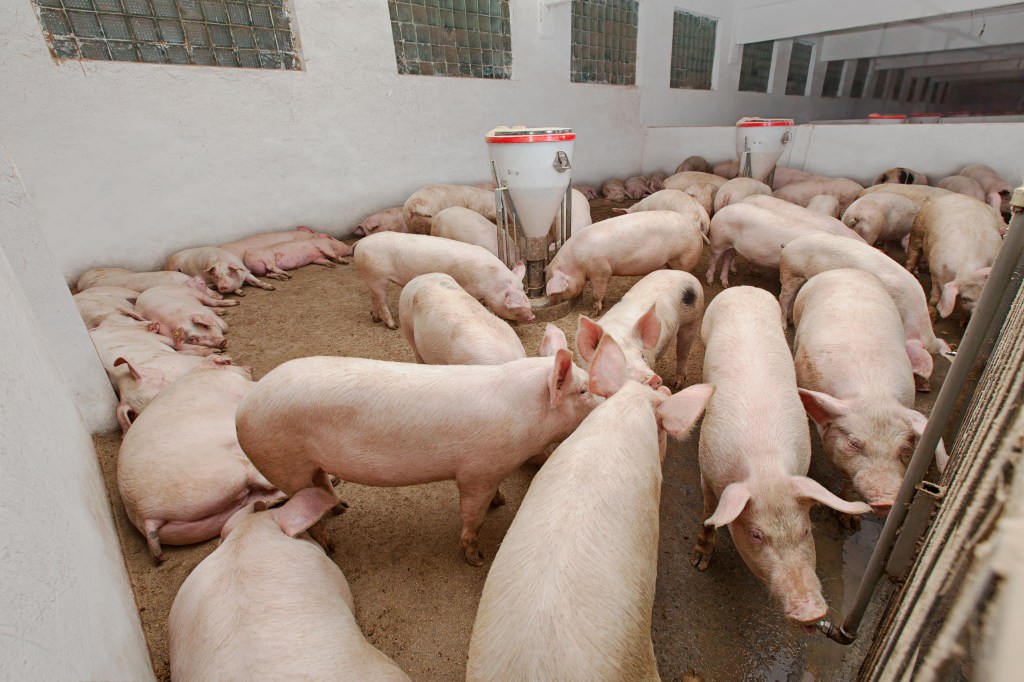
Fig 1: Large white pig breed in a modern day sty.

Feeding

The next thing we’re going to consider is feeding. Food plays a very vital role in the lives of pigs and therefore selecting the right kind of feed to feed them is of utmost importance. Even though pigs have a very high food to meat conversion ratio and can basically consume any type of food, feeding the pigs is the most costly expense of raising the pigs as it may consist up to 85 per cent of their total expense cost.

Therefore you need to learn more about their feed in order to provide quality feed for them whilst reducing or minimizing the cost. It is advisable for beginners to purchase commercially prepared feed and supply them with leftovers and other foods.

You can, however, prepare your own feed for them after gaining some experience and learning about your pigs’ diet. Furthermore, it is advisable to include proteins and vitamins in their diet as well as other supplements that help to boost their immune system. For instance, piglets require feed with a relatively higher protein content compared to the adults.

Housing

Now, we need to consider where to keep the pigs. You need to build a permanent structure to keep your pigs. Pigs are powerful animals, however, because of their fatty bodies, they are not able to withstand high temperatures.

The sty should be constructed to ensure that it prevents the sun from scorching the pigs. Therefore the position of the sun should be considered during construction to ensure that shade is provided for the pigs all day long. The sty should also be well ventilated to enhance the proper circulation of fresh air. Ensure the sty is ever clean and dry to facilitate maximum health care.

Breeding

Let us now consider breeding and the fertility of the pigs. Breeding pigs is quite easy since they are ever fertile, and they tend to have a shorter gestation period when compared to cows. A sow reaches maturity after about 8 months, and she has the capability of giving birth.

In a year, a sow is capable of giving birth to about 10-12 piglets at a go twice. It is advisable to separate piglets from their mothers so that they can grow and mature faster. Because pigs breed very quickly, it is highly advisable for startup commercial farmers to start with a smaller number and gradually increase their stock.

Fig 2: A sow breastfeeding her piglets.

Marketing

Lastly, we need to consider the marketing of the pigs. Fortunately, Ghana has a massive demand for pig products as compared to other countries. Some of the ordinary pig products are pork, bacon, and Sausages, among others. If you’re venturing in pig farming in Ghana, then you need not worry about the market. You can sell your pigs to the nearest local market or direct to the Farmers’ Choice Industry nearby.

Semi processed pigs, that is, pigs that have been slaughtered, weighed and packaged, usually cost more than selling the live animal. It is therefore advisable to get a freezer and some butchering equipment so that you can slaughter, store the meat and sell it at relatively higher prices.

Conclusion

I think one mistake first time pig farmers make is this idea of starting a big production unit without a good understanding of all the factors needed to make them successful.

Avoid the common mistake of investing too much money into structures and only to realize at a later stage that the infrastructure is lying idle, whilst at the same time you have problems taking care of the pigs. A good business plan can help in avoiding such mistakes.

If reading this article piqued your interest in starting your piggery venture, it will be in your best interest to write a good business plan. Even if you don’t necessarily have the time to write your own, don’t worry. Just send us a WhatsApp message by following this link https://wa.me/233592239127. And we’ll draft a professional business plan for you at a very reasonable price.

How to Calculate Profit for Layers

©Shutterstock Chicken hens eggs in farm.

Before I even proceed with writing the article, let me explain what a layer poultry farm is. A layer poultry farm is the type of farm that raises chicken solely for the purpose of producing eggs although occasionally, the birds are sold off as meat as they near the end of their laying period.

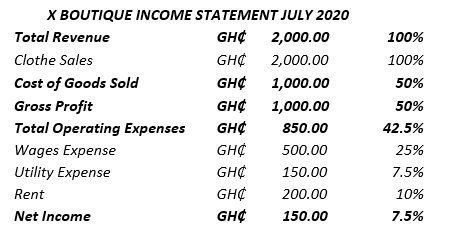
Now, calculating the profit or loss of a layer farm is not as easy as it seems. For a normal merchandising enterprise, you have two forms of expenses i.e. cost of goods sold and operational expenses. For instance, if you are running a boutique your expenses include the cost price of the clothes you are selling and the operating expenses associated with selling the clothes such as rent, workers’ wages, and utilities.

To continue with my example, let’s assume in the month of July 2020, you sold 20 clothes for GH¢ 100 each, here is how your profit is going to look like assuming the cost price for the clothes are GH¢ 50 each, storekeeper’s salary is GH¢ 500, rent is GH¢ 200 and utility expense is GH¢ 150.

As you can see from the table above, the net income or profit for the month of July is GH¢150.

So we were able to determine the profit for our hypothetical boutique here but wait a minute. Aren’t we rearing layers? If we are rearing layers, how then do we determine the cost of goods sold since we don’t purchase our eggs directly from suppliers but rather, it is the hens that lay the eggs?

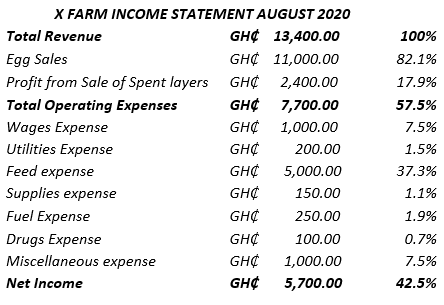
Calculating the profit made in a particular period, say August 2020 is not as simple as calculating that of a merchandising business. Let’s assume we rear 1,000 birds; during the course of August, we sold GH¢ 11,000 worth of eggs and 200 spent layers for GH¢ 4,000 taking our total revenue for the month to GH¢ 13,400.

Now I know what you might be thinking, “Is Papa Kwame serious, so he cannot do a simple addition of GH¢ 11,000 and GH¢ 4,000 to get GH¢ 15,000?” Chill out, I know what I’m doing. You see, what I haven’t yet told you is that the cost of a day-old chick for each spent layer sold is GH¢ 8 so we multiply that by 200 and subtract from GH¢ 4,000 leaving us with GH¢ 2,400. After that, we add the GH¢ 2,400 to GH¢ 11,000 to make GH¢ 13,400. I am going to explain why we subtracted the cost of the day-old chicks very soon so please stick around.

So now let’s talk about the expenses. Let’s assume in the month of August, we spent GH¢ 1,000 on wages, GH¢ 200 on utilities, GH¢ 5,000 on feed, GH¢ 150 on supplies, GH¢ 250 on fuel, GH¢ 100 on drugs, and GH¢ 1,000 on miscellaneous expenses.

Putting everything together this would be our income statement for August 2020.

From the table above, you can see that the net income or profit for the period of August is GH¢ 5,700 which is calculated by subtracting total expenses of GH¢ 7,700 from the total revenue of GH¢ 13,400.

You remember earlier in the article, even though we sold 200 spent layers for GH¢ 20 each, I recorded the revenue for that transaction as GH¢ 2,400 instead of GH¢ 4,000. The reason why I did this was that the layers are assets since they were purchased as day-old chicks purposely to mature and lay eggs. Therefore, in the event we sell any of them, we are merely transforming one asset (layers) into another asset (cash) which is termed liquidation. So we only record revenue with respect to the spent layers when we sell them in excess of the price of which we purchased them as day-old chicks which in this case is GH¢ 2,400.

Finally, Feed expense is not the amount of feed you purchase in a particular period but rather the amount of feed the birds consume. For instance, in our example, we might have purchased 60 bags of layer mash at the beginning of the month but at the end of August, only 6 bags of feed were left. This means the birds consumed 54 bags of feed within that period hence we end up with a feed expense of GH¢ 5,000 assuming each bag costs GH¢ 93.

In conclusion, calculating the profit for a layer operation is not as easy as it sounds so I hope this article has been informative enough to guide you on how to make such a calculation.

If reading this article piques your interest in starting your poultry venture, it will be in your best interest to write a good business plan. Even if you don’t necessarily have the time to write your own, don’t worry. Just send us a WhatsApp message by following this link https://wa.me/233592239127. And we’ll draft a professional business plan for you at a very reasonable price.

Are you tired of too much paperwork involved in keeping records on feed, egg collection, vaccination, mortality, profit, and loss, etc.? Worry no more. We are developing a software application that simplifies poultry management. Follow this link if you are interested.

Finally, are you ready to start your dream poultry farm, but don’t know how to construct the chicken house, brood the chicks, source the right materials, etc.? Just follow this link https://wa.me/233592239127 for more inquiries.

This is how Your Farm Could Collapse in Only Three Months

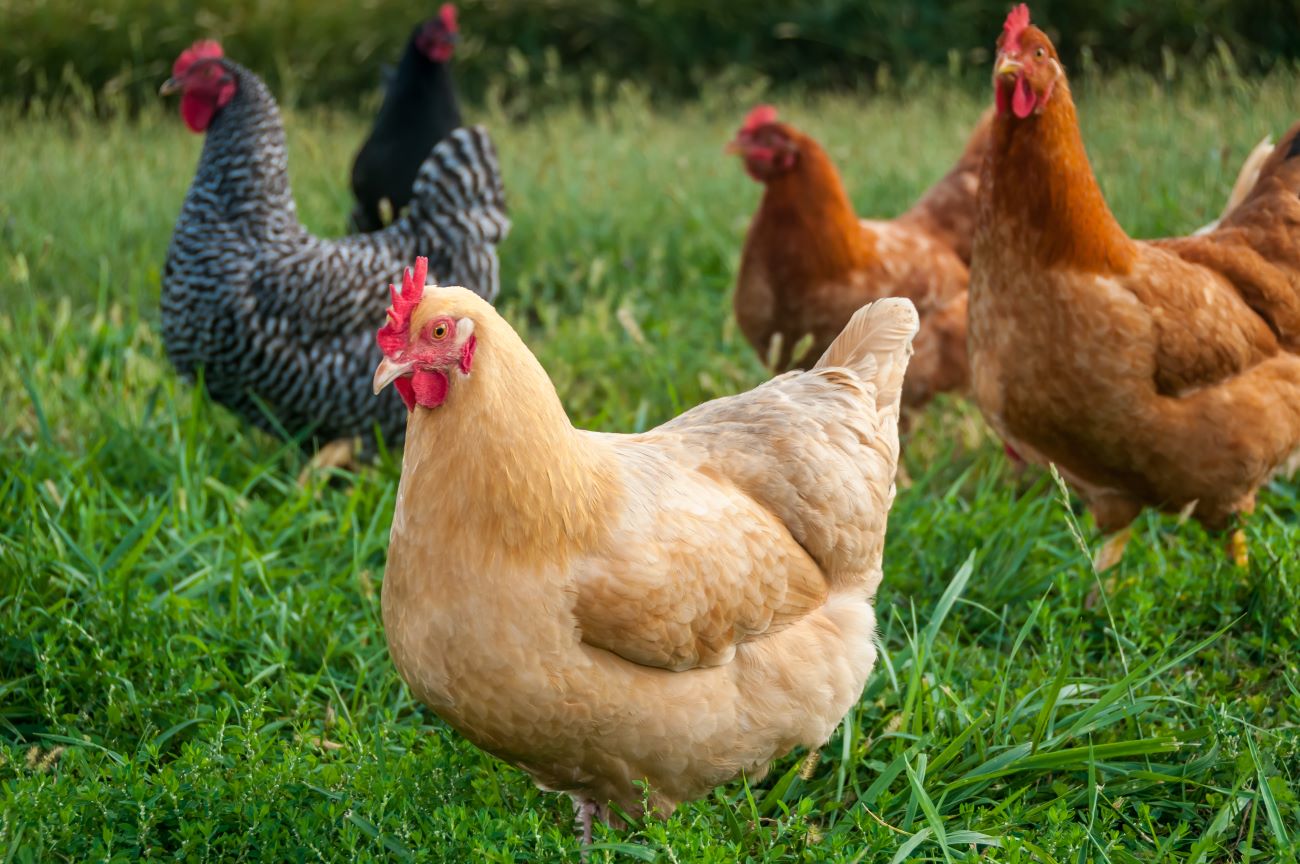
©Shutterstock Free Range Chickens.

It is such as shame that as of today, many farmers still believe that animal husbandry knowledge alone, is enough for them to succeed as poultry farmers. Don’t get me wrong, treating your birds like sh*t wouldn’t help either – not even if you have a PhD in Business Management. All I’m trying to say is having basic financial skills such as making good revenue and cost projections could very well be the difference between success and failure.

In this article, I will be explaining how you could easily go out of business in just three months due to financial miscalculation.

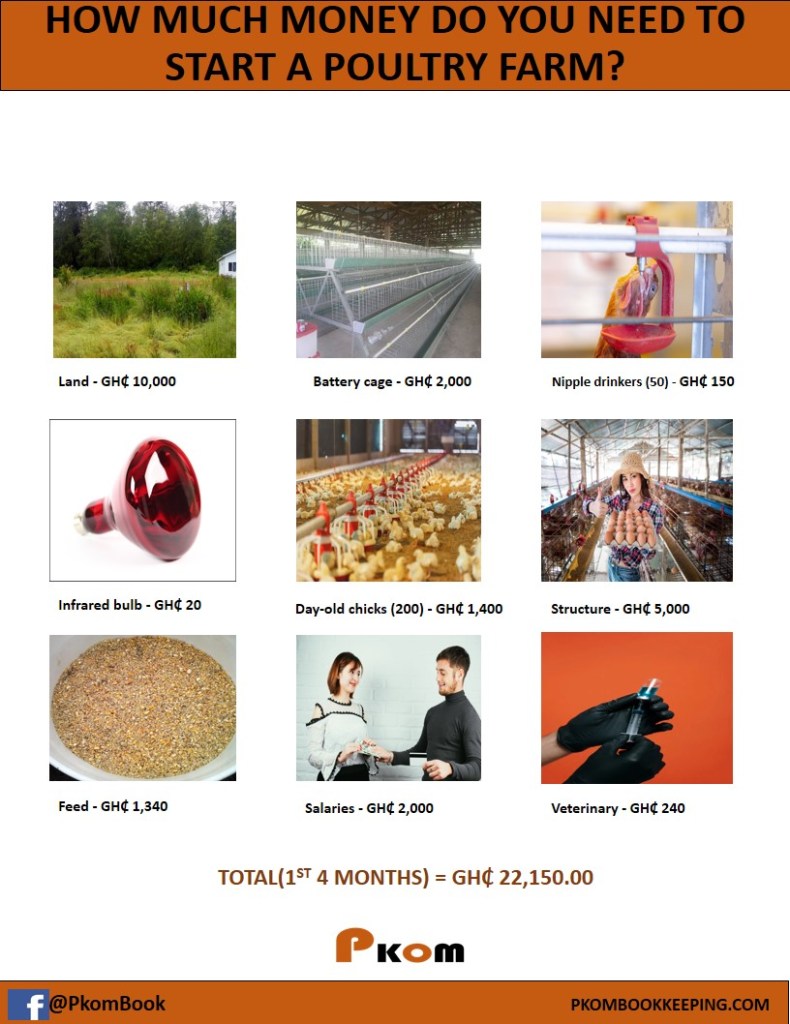
To explain further, let’s consider this scenario; Akosua might think because she has GH₵ 10,000.00 she can comfortably rear 200 layers because a day-old layer costs GH₵ 7.00 meaning 200 day-old-layers will cost her GH₵ 1,400.00 so GH₵ 8,600.00 will be left. But wait a minute, is her idea feasible? Let’s find out from the photo below.

From the photo, you could deduce that because Akosua already has land and has purchased the day-old chicks, she will need an additional GH₵ 10,750.00 to run the farm for 4 months. But how much does she have left? GH₵ 8,600.00. In this situation, her farm will collapse in only 3 months if she doesn’t raise additional capital. Now, if She had instead ordered for 100 day-old chicks, she would have only needed to raise around GH₵ 6,600 (well within her GH₵ 10,000.00 budget) to run the farm for the first four months until the birds start laying.

So dear reader, will Akosua’s farm fail because she doesn’t know how to raise chicken? Obviously not!

Need a Business Plan for Your Poultry Farm?

What is a business plan?

A business plan is a written or unwritten document which describes the operational and financial objectives of a company and how the company seeks to achieve them. As a new poultry farmer, it is very crucial to prepare a business plan because, the business involves several complex financial obligations like feeding, veterinary visits, labour and possibly fuel. Preparing a business plan will ensure that you are properly equipped with a good estimate of how much you are supposed to spend and how much revenue you are to expect. In case you need help with your business plan, please visit http://www.pkombookkeeping.com/contact.

What I Have Learnt from the Coronavirus Pandemic as a Poultry Farmer

©Shutterstock Chicken farmer wearing personal protective clothing on a farm in Asia.

The Covid-19 pandemic significantly disrupted Ghanaian agriculture and forced players across the agriculture value chain to remodel day-to-day operations. With agriculture declared an essential industry, farmers continued to farm despite disruptions at every stage of the agri-supply-chain.

Health and safety concerns aside, there were several challenges on the ground. With the partial closure of local markets, farmers were unable to sell their produce in physical market places, and therefore, faced liquidity challenges.

Restrictions on movement and closure of state and national borders affected transportation of agri-produce from farms to markets and of essential seeds and crop protection products from factories to markets.

The closure of schools significantly affected some poultry farmers. Birds kept laying but the demand for eggs fell significantly. Schools particularly, Junior High and Senior High schools were closed down – and because they account for significant demand for eggs – farmers were adversely affected.

Selling broilers in the height of the pandemic was also difficult largely because people were cash strapped. As you already know by now, broilers are quite costly. This year’s Eid-ul-Adha was considered one of the worse from a business viewpoint by some farmers I spoke to – some reporting a drop in sales by about 50% compared to the previous year.

Lessons have been learned and these strategies will help you continue operations if anything like that occurs in the future.

E-commerce

During the pandemic, there were so many restrictions making it difficult for farmers to sell eggs and meat in the open market. For this reason, farmers need to find alternative ways to sell their birds. You can try advertising websites like Tonaton and Jiji to promote your products.

Creating a website

Create a professional website, eye-catchy logo, and optimize the site with store images, in-house videos, location, and social links to show the credibility of the business. Increase awareness and market reach through your social media pages. You can start posting images on Facebook and Instagram.

Home delivery of products

Start a home delivery through a website or an application to provide more customer satisfaction.

The concept of home delivery is important because many people want fresh eggs in the comfort of their home as they don’t want to go to the grocery store.

Join Farm Associations

It is a cost-effective way to sell your farm products. The membership fees are quite modest and benefits include newsletter subscription and web-based listing in the directory. Hence many people get to know about your business. You also get to learn more from other farmers this way.

Build A Listing Or Database

Most importantly, if you want to increase the sale of your poultry business, first build a listing or database of all customers that have ever contacted you. This is very important as it will give you a ready market that is only a phone call or email away.

Buying feed and vaccine in bulk

Buying feed and vaccines during the lockdown was tough, therefore, farmers need to consider buying these things in bulk such that when the unexpected occurs, they won’t struggle to look for feed for their birds and vaccines to protect them from illnesses. But a little word of caution – always check expiry dates of vaccines before purchasing them in bulk.

Reasons Why Poultry Farmers Should Consider Automation

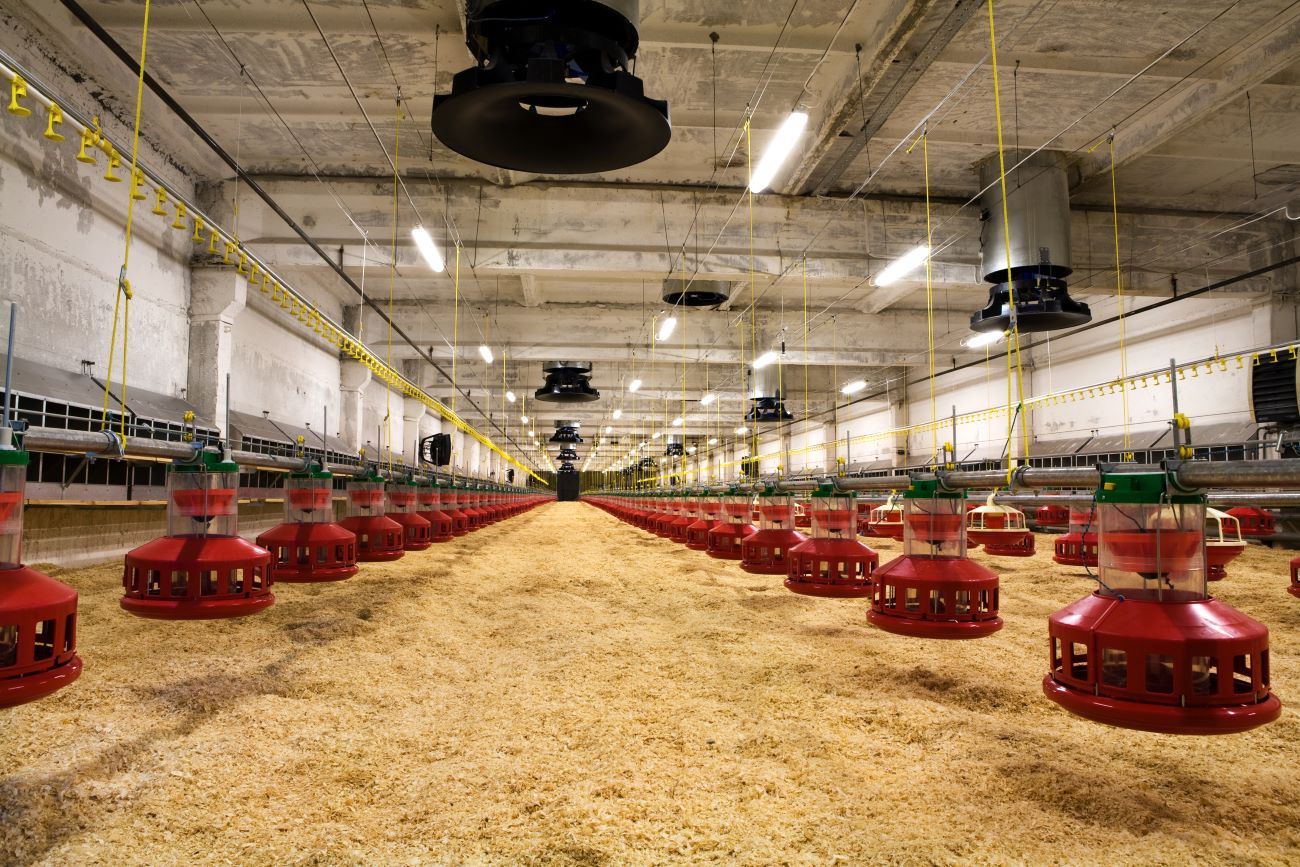
©Shutterstock The modern and new automated integrated poultry farm.

The government of Ghana has hinted that by the end of the year 2023, there shall be a ban on importation of poultry products, particularly frozen chicken into the country.

This directive, should it come into being, will imply that there will be a surge in demand for poultry products – and for that reason – local poultry farmers will have to work hard to be ready to meet the new demand.

Obviously, demand cannot be met with the current old-age strategies being used currently. The only way the demand will be met is by increasing capital investment in the industry. Such a huge influx of cash will mean that the farmer can go fully automated. The rewards for such are enormous.

I would recommend to any potential client (new farmers in this case), if they have the means, to consider automation.

What’s automation in poultry farming and what are the benefits? Automation is the use of automatic equipment in the farming process to increase productivity. Some benefits of automation include more efficient use of materials, better product quality, improved safety and lower labour costs.

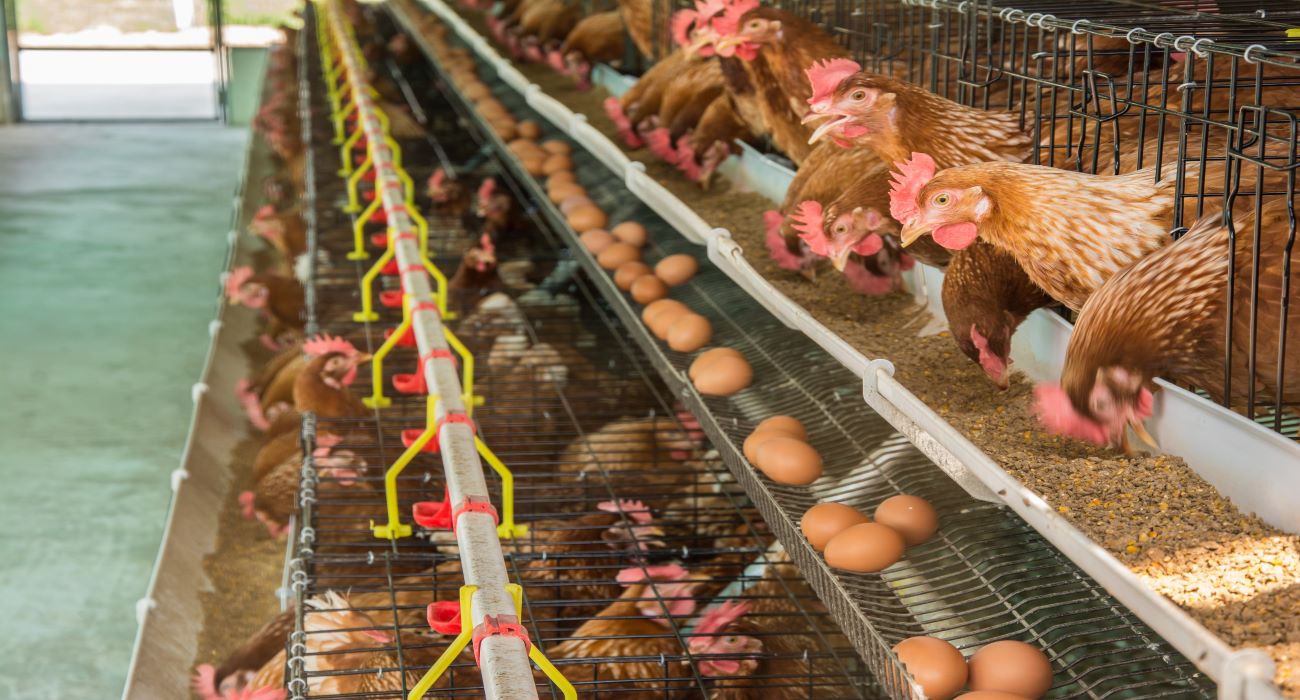
This is an example of how automation can make your work easier as a poultry farmer; you don’t need to be moving up and down trying to get the water troughs full. An automated system ensures that the main tank is connected to the drinker at all times. Also, eggs can be collected into a specialized chamber when the battery cage system is used, therefore, cannibalism in the form of egg pecking is eliminated.

We always encourage people to make sure they prepare very well financially before deciding to get into the industry. That said, you can start with the deep litter system and gradually automate your farm if you can’t get the needed capital upfront – what matters is you have a grand vision and take the baby steps toward achieving it.