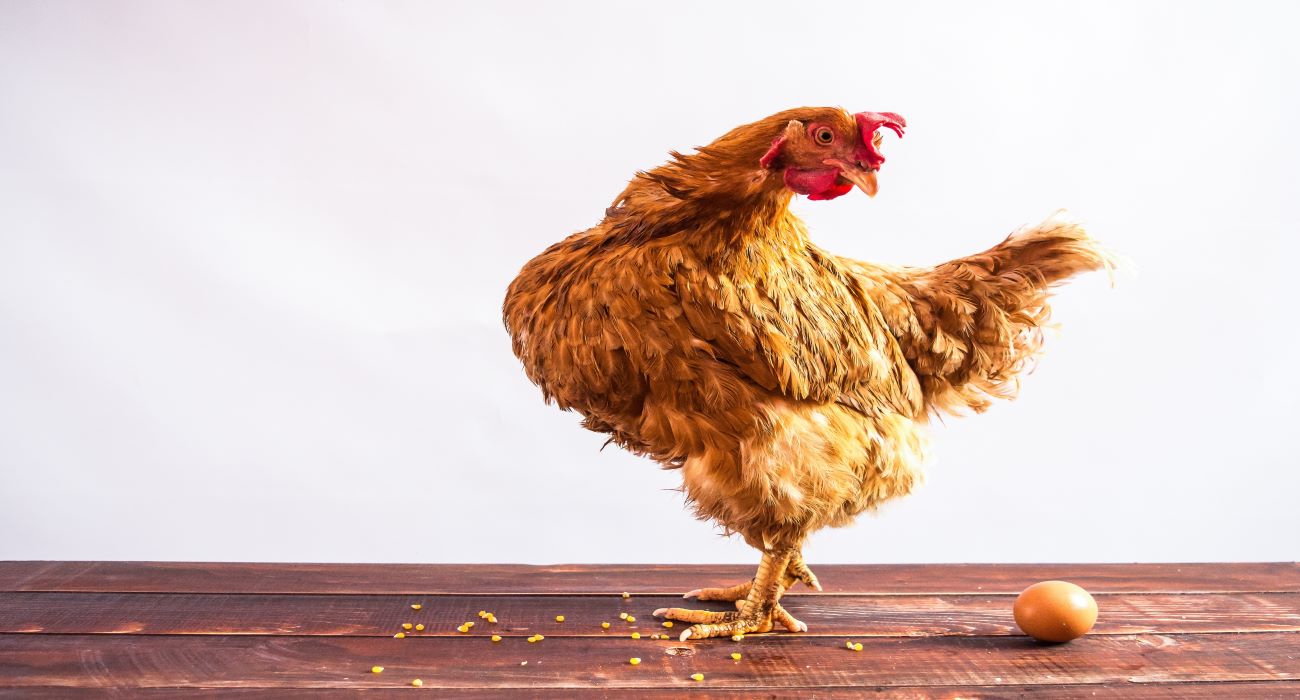
This question may seem unanswerable to the average person because it seems every chicken hatched from an egg and every egg was laid by a chicken but there is an answer to this.
Christian and Islamic Viewpoint
According to adherents of these two major religions, God created the entire universe and all animals in it therefore the chicken came first which later laid eggs which hatched into more chickens.
Scientific Viewpoint
According to the theory of evolution, species change over time due to environmental and genetic factors. For example, a very early ancestor of birds (probably some amphibian) laid eggs without a protective layer into water bodies to keep the embryo moist but because of the lack of protection, the eggs were exposed to predators so along the line, the species evolved to lay eggs covered by protective shells. Furthermore, because the eggs were enclosed, they were protected against desiccation (drying up) hence they were laid on land instead of in water, where most of the predators could be found. It was out of one these eggs that the modern chicken (Gallus gallus) arose. Therefore, according to science, the egg came first.
Conclusion
Due to my background in Molecular Biology and Biotechnology, I am a proponent of the scientific view that the egg came first. So what about you, do you agree or disagree?
The health of chickens is one of the most important factors that can determine the success or failure of any poultry farm and one sure way to ensure that birds are healthy, is by providing them with quality nutrition. The fact that proper nutrition results in quality products is undisputed but the problem is feed is not cheap. To reduce costs as much as possible, many farmers are confronted with the decision of whether to purchase already formulated poultry feed or prepare their own.
Nutrient Requirements of Chickens
Carbohydrates: Carbohydrates are required for energy production. A typical source of carbohydrates in poultry feed is maize.
Fats: Fats also provide energy for birds.
Proteins: These are necessary for building muscle tissues and also for the production of eggs. Fish meal is the common source of animal protein in poultry feed but nowadays, maggots are being touted as a viable animal protein alternative.
Vitamins: Vitamins are organic compounds that help chickens’ metabolism and other body processes.
Minerals: Minerals such as calcium are important for bone formation and also for the production of shells.
The Decision
You must understand that to prepare feed that includes all the nutrients listed above in the right proportions, some expertise is required. Also, you must ensure that in preparing the feed you do not expose the components or finished products to microbial contamination. Furthermore, establishing a feed mill which meets all the necessary safety requirements may need substantial investment. So in general if you are running a smaller farm of capacity ranging from 200 to 1000 birds, then purchasing already formulated feed may be a good option but when you are operating at a very large capacity then investing in feed formulation infrastructure could save you thousands of Ghana cedis in the long run.
Poultry Politics Ltd is a startup company which will supply families, hotels, restaurants, “chop bars”, cold stores, corporate bodies, professionals (teachers, bankers, etc.), social groups and the general public with high-quality poultry products such as broiler meat, layer meat and eggs. The Co-founders have a solid background in Microbiology so they realize the importance of adhering to strict hygienic practices so that the quality, taste and general health value of our products will not be compromised.
General Company Description
Poultry Politics LTD will be based in Takoradi, Western Region and is a poultry processing and distribution company with the sole of aim of adding value to locally reared broiler and layer meat and also the supply of eggs. Our operations will not only be beneficial to the end customer but also be beneficial to poultry farmers since they will have the opportunity to indirectly market their products through us. Poultry Politics will partner chiefly with cold stores and poultry farmers by soliciting their input and suggestions to effectively develop a product concept which will be of immense value to all parties.
Market Analysis
The size of the poultry market in Ghana is estimated to be around GHS1.2 billion and expected to grow by 25% by 2025. Government’s intention to place a ban on all imported chicken meat makes the local poultry sector even show more promise of impressive growth. Majority of the chicken meat market is being held by imported frozen chicken from the United States about 35%. Notable competitors include imported chicken dealers, market women dealing in live broilers and layers, and poultry farmers who deal directly with customers. A deeper analysis of our competition and potential customers will be made during our market research.
Products
Dressed and neatly packaged broiler meat
Dressed and neatly packaged layer meat
Live broilers
Live layers
Eggs
Marketing Plan
Our customer base will be divided into three groups namely, primary customers (Cold stores), secondary customers (restaurants and ‘chop bars’) and tertiary customers (corporate bodies, social groups and the general public). We are going to distribute products directly to our customers. Poultry Politics is going to employ different advertising strategies to effectively reach potential customers. Advertising strategies we are going to employ include website, Facebook ads, banners, fliers and direct email.
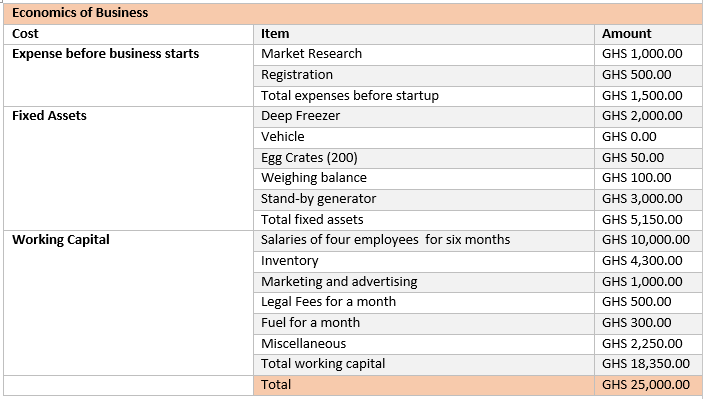
Economics of Business
Operations Plan
Poultry Politics broiler and layer meat will be dressed at home. Plans are being put in place to secure funding to build a chicken slaughterhouse facility in 2 years. Production of eggs, layers and broilers will be outsourced to poultry farmers within the Sekondi-Takoradi vicinity. Because we want to test the market, we will begin with 200 broilers which will be produced by Papa Kwame Owusu-Mensah’s mum. If we are successful in marketing all of the 200 broilers within a month, then we can think of expanding our operations by seeking more funding. In the first year of our operations, our distribution channel will be direct (online) and retail (via cold stores). Starting from the beginning of the fourth quarter of our second year of operations, an additional direct distribution channel (Cold store/ Egg depot facility) will be utilized.
Management
Papa Kwame Owusu-Mensah: co-founder and Chief Strategy Officer is a final year BSc Molecular Biology and Biotechnology student of the University of Cape Coast who has experience in sales and customer relations.
Eric Umkhonto Frimpong: co-founder and Chief Operations Officer is a final year BSc Molecular Biology and Biotechnology student of the University of Cape Coast who also has some experience with door-to-door trade and personal branding.
Francis Eshun: co-founder and Chief Marketing and Technology Officer is a final year BSc Molecular Biology and Biotechnology student of the University of Cape Coast who has expertise in marketing and also very adept with modern technology.
Critical Risks
Risk of Disease outbreak
Stiff competition from cheap imported products
Risk of unstable power supply
Financial Plan
Basis of presentation This plan consists of the five-year projected financial information of our company. Even though our management believes these financial projections are reasonable enough, there can be no assurance that these projected figures will match those that occur in reality. It is worthwhile to note that our first month of the opening is likely to be in September 2020, causing the Christmas season to be reflected in the financial statement.
Income statement assumptions- revenues
The number of dressed broilers sold every month is the major driver of revenue for our company. Sales of eggs and dressed layers will also contribute significantly to our revenue streams.
The number of units sold per product
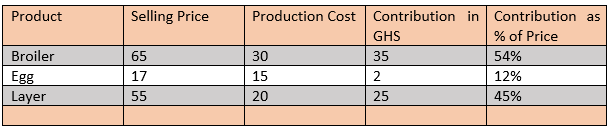
Poultry Politics dressed broilers and layers will remain at the high-end segment of the market for at least the first 3 years of operations. For the eggs department, both the high-end and the mid-segment sections will be served. When pricing our products, we consider the market segments.
Prices and production costs
Poultry Politics will sell its products both online (direct) and through specialty retailers (cold stores). In the 4th quarter of year two, management plans on renting a store in Takoradi which will serve as a cold store and an egg depot; this will be a second direct distribution channel.
Revenue forcasts
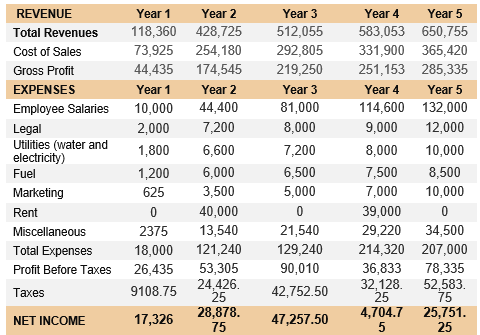
Projected income statement
If reading this article piqued your interest in starting your poultry venture, it will be in your best interest to write a good business plan. Even if you don’t necessarily have the time to write your own, don’t worry. Just send us a WhatsApp message by following this link https://wa.me/233592239127. And we’ll draft a professional business plan for you at a very reasonable price.
Are you tired of too much paperwork involved in keeping records on feed, egg collection, vaccination, mortality, profit and loss, etc.? Worry no more. We are developing a software application that simplifies poultry management. Follow this link if you are interested.
Finally, are you ready to start your dream poultry farm, but don’t know how to construct the chicken house, brood the chicks, source the right materials, etc.? Just follow this link https://wa.me/233592239127 for more enquiries.
Poultry products are the most widely consumed products in Ghana. And for that reason, the poultry industry has the potential to be the biggest in the country, unfortunately, several factors have hampered the industry because the full potential of the industry is yet to be exploited.
The average Ghanaian consumes poultry products particularly meat or eggs once or twice in a day. Egg production is very predominant in the country because of the absence or lack of competition from foreign products.
Same cannot be same about broiler Production – largely because the alternative for consumers is cheaper. Imported chicken is less expensive compared to chicken produced in Ghana.
You have more poultry farmers who prefer to invest in egg production. Layers take 16 weeks before they start laying eggs. The cost of feeding them until they start laying eggs is huge. This discourages so many new investors. Broilers take 6 to 8 weeks until they are ready for the market. Their fast-growing nature appeals to many farmers but the problem associated is one and only one: MARKET FOR THE BIRDS.
All things being equal, consumers will go for chicken which is cheap. That has discouraged so many farmers from investing in broiler Production.
What are some of the ways poultry farmers can use to get demand for broilers?
Here, we seek to give answers.
Producing broilers for occasions
It’s an undeniable fact that poultry products are the most popular source of protein for many Ghanaian homes. And chicken is consumed by many families during general festivities such as Christmas, Eid, Easter et al.
6 to 12 weeks to the celebration of these festivities, it’s important to start producing the broilers. Demand for chicken hit its crescendo during these periods. People usually prefer to buy live chicken compared to frozen.
Broiler farmers are likely to make a lot of money during this period.
Marketing broilers to Restaurants, Hotels etc
Form cooperative associations with other broiler producers
Broiler producers are encouraged to prepare professional proposals and share them with hotels, restaurants, eateries et al. They require a lot of chicken in cooking for their customers. Imported frozen chicken has always been said to have some health concerns so many restaurants and hotels prefer fresh live chicken. As a broiler producer brand yourself well and surely you’ll get clients to buy from you.
Form cooperative associations with other broiler producers
It is always said that, two heads are better than one. It is important for broiler producers to come together and form a cooperative union and negotiate with retailers of poultry chicken. This helps to get a better price, clients and a common voice.
Scout for buyers from house to house with posters
Marketing is said to be the creation of awareness about the existence of a certain product or service. Don’t stay in your poultry farm and expect people to know you have broilers and they will come and buy. Go out there and tell people you have broilers to sell. You may never know who may be interested in buying your products.
Design posters and put them in strategic. You may never know who will see it.
Create a page on Facebook and market your broilers
As has been explained earlier, it is important to create awareness of the existence of broilers. Facebook is the biggest platform momentarily to sell your products. You have so many people on that platform and of course, you may never know who will see your advertisements and further give you the cash you are so much interested in.
Conclusion: As has been said earlier, selling broilers is difficult due to obvious reasons but with the strategies outlined, surely you’ll get your broilers sold.
The poultry industry is massive and still growing so wherever you find yourself in the poultry value chain, be rest assured that when you do things right, you are going to make massive profits. With that said, as a prospective entrepreneur or investor, I am sure you may be wondering which aspect of the value chain provides the best returns; whether to start a farm or to sell products. I am going base my decision on which aspect of the value chain is more profitable on the five criteria below.
The barrier of Entry: It is more difficult to set up a poultry farm as compared to just retailing products such as eggs. In setting up a poultry farm you may require special government licenses and abide by some environmental protection rules. Most people would not want to or are incapable of going through all this process so the very few that are a part of this value chain enjoy some significant profits. Farm 1:0 Products
Scalability: For this criterium, the ease at which a business can be expanded is taken into consideration. In this case, it is very difficult and costly to expand a poultry farm; you need to purchase more equipment, hire more workers and potentially face more regulation hurdles. On the other hand, you can create a simple Facebook page and sell products to people nationwide without spending a dime of your own money; https://tinyurl.com/ycga7zej is the link which explains this in detail. Farm 1:1 Products.
Capital Intensiveness: Again, if you are a poultry farmer rearing layers, for example, you need to spend money on feed, vaccines, drug, supplements, etc for four months straight before obtaining any form of revenue but an egg distributor has lower overhead for selling the same products. Farm 1:2 Products.
Level of Skill required: Why do you think surgeons earn more money than cleaners? It is not because surgeons save lives but rather, it is just relatively few people who have the skills to perform medical operations – because the demand for surgeons is way higher than their supply, they (surgeons) tend to enjoy higher salaries. If you examined poultry farming into much detail you would realize that animal husbandry and managerial skills are required while the distribution of poultry products such as eggs don’t require any special skill hence we have far a greater number of distributors as compared to farmers. Farm 2:2 Products
Return on Investment (ROI): This is a measure of how efficient an investment has been. ROI is calculated using the formula below
ROI = Current Value of Investment – Cost of Investment× 100 Cost of Investment
It is worthwhile to note that starting a poultry farm requires a lot of startup capital in the purchase of land, construction of a structure, etc, therefore, it may take a relatively long period to fully recover your investment let alone, make a positive return. (By the way don’t confuse ROI with profit because, in calculating profit, the purchase of land or buildings are not considered as expenses). In contrast, let’s assume you spent GH₵ 1,000 on a website, and you sold GH₵ 20,000 worth of products in one year with a gross profit of let’s say GH₵ 7,000, your ROI becomes 50%. Therefore, selling products usually promises a faster rate of return as compared to farming. Final score,
Farm 2:3 Products.
Conclusion
If you consider the five factors outlined above, then selling farm products has a slight edge in terms of profitability. It is also important to note that because selling products seem to offer a quicker return, the market is more saturated as compared to poultry farming hence farmers enjoy relatively less competition.
In a previous post, https://tinyurl.com/yd2ys776 I described how you could collapse an already profitable poultry farm by attempting to expand it but on this occasion, I am going to describe how you could scale up operations the proper way.
Year 1
I always encourage people to start small so in your case, you are going, to begin with, 200 layer birds. If you want to find out how much it will cost you to raise 200 birds, please follow this link https://tinyurl.com/y89x74p8. Now let’s assume you initially invested GH₵ 20,000, you can expect that money to last only about four months so you may need to invest another GH₵ 3,500 for this business to run for the first year. So at the end of year one, the money that will be left in your account will probably be GH₵ 250.
Year 2
At this point, you may be thinking, “How the hell I’m I supposed to reach the 10,000-bird milestone if I have only GH₵ 250 left in my account?” Please, be patient we will get there soon. At this point, you have gained valuable experience in poultry farming so now you can book 400 day-old layer chicks for around GH₵ 3200. Now, if you project into the future, you may make an average monthly revenue of GH₵ 2100 per year and expenses of GH₵ 8,400. This means for year 2, you probably have to take a loan of GH₵ 78,550.
Year 3
In January of Year 3, you’re probably going to sell the initial 200 layers as spent layers so we expect that they will bring in around GH₵ 5,000. At this point, you’ve proven yourself worthy to care for a relatively large number of birds so we just straight to booking 5,000 birds which would cost around GH₵ 42,500. Around this period, average monthly revenue is expected to be in the region GH₵ 50,000 and expenses around GH₵ 55,000. Therefore, you probably need to raise GH₵ 152,500 to run the farm for year 3. Follow the link, https://tinyurl.com/y8doqvxn to find out how you can raise money to fund your operations.
Year 4
At this point, you would have sold the 400 layers as they no longer lay eggs productive so you can expect to recoup GH₵ 10,000. You are now going to book 7500 day-old layers and this would cost you around GH₵ 63,750. This particular year you are expected to make GH₵ 950,000 in revenue and GH₵ 860,000 in expenses so this means, you end the year with GH₵ 90,000 in profit.
Year 5
At the beginning of year 5, we assume that your farm begins with a bank balance of GH₵ 140,000 so you are going to finally purchase 10,000 day-old layer chicks.
Conclusion
As you can see, it is not very easy to reach a 10,000-bird capacity in 5 years so if it will take you longer to reach this goal, say 10 years that will also be great. All I want to say is that even though you should strive to grow your farm, you should fully understand the costs involved.
You may be thinking, “but PKOM if I want to make a lot of money, then I should have a very large farm because having a large farm means I make more revenue hence more profit.” But you should understand that growing your business comes at a cost. Firstly, growing your business may increase your workload since, by that time you have more customers to take care of, you need to manage more employees and also ensure that all equipment is running efficiently. Furthermore, large businesses tend to have larger overhead as compared to their smaller counterparts. For example, if you rear layers, some costs you will incur include feeding, utilities, etc. Let’s say you already rear 200 layers and make an average monthly profit of GH₵700 from selling eggs. You are quite impressed about how lucrative the business is so you go in for 300 additional birds. With the additional 300 birds booked, it is estimated that your average monthly revenue will be GH₵ 5,335.9 while your expenses are expected to be in the region of GH₵ 7,069. At this rate you are burning through GH₵ 1,733 per month or GH₵ 20,797 per year, meaning if you fail to raise GH₵ 20,797 in that year, you can kiss your farm goodbye.
Conclusion
I am by no means implying that you shouldn’t grow your farm but what I’m warning you about is that there are costs involved in larger operations so always make sure you do due diligence and analyze the financial situation of your farm before any attempt to scale up operations.
Bookkeeping simply refers to the practice of recording the day-to-day financial transactions of a business. Furthermore, a transaction is any event that alters the economic condition of a business – for instance, when you purchase day-old-chicks, the amount of money in your farm’s bank account decreases conversely, when you sell some broilers, the cash balance of your farm’s account increases. Many farmers take bookkeeping for granted, therefore, I am going to describe some important benefits your poultry farming can derive from it.
It helps you track the progress of your farm: Is your farm making a profit or is it burning through cash? Bookkeeping will help you answer this question. Keeping track of your revenue and expenses can help you devise a strategy on how to increase profitability. For example, you rear 1,000 layers and you give them water via 100 manual drinkers. Every single day you have to pay someone GH₵ 15 day just to wash them (the drinkers) which means you’ll spend GH₵ 5,400 per year on that but a simple decision of paying GH₵ 2,000 for a plumber to upgrade your water delivery system to an automatic one will save you GH₵ 25,000 in five years. That my friend, is the power of bookkeeping; it helps you to evaluate your farm’s performance and helps you eliminate unnecessary expenses.
It helps you prepare better budgets: So let’s assume you are a young farmer who runs a 200-layer farm but there is an opportunity to get a government grant of around GH₵ 50,000 as an incentive to encourage more youth to venture into agriculture. Obviously, you are going to potentially compete with many other candidates, therefore, your ability to show how you are going to put the money to good use will give you the competitive edge. Now, if you were serious about bookkeeping in the early stages, you would by now have had enough financial knowledge to articulate your vision on how to utilize the GH₵ 50,000. It will be easy to explain to your audience the cost of labour, feed, etc and how that money can help you run activities smoothly.
It will help you know whether you can afford an additional employee or not: What is the first thing that comes to the mind of CEOs when their companies start to struggle financially? You guessed right, they lay off some of their workers. I’m sorry to burst your bubble but if you are currently working a job, your employer probably only sees you as a necessary expense and would not hesitate to kick you out if he could automate your job. Let’s examine this scenario, you run a farm with about 900 birds but currently, you have one employee who you pay roughly GH₵ 600 per month but there is still a ton of workload on you, it will make sense to hire an additional employee whom you will probably just pay GH₵ 500 per month assuming you make an average profit of GH₵ 2500 per month. In this case, bookkeeping will save you from unnecessary stress since your records will confirm that your business is profitable enough to financially handle an additional employee. Please follow the link, https://tinyurl.com/yb7uw538 for more info on hiring employees.
Bookkeeping helps you meet important deadlines: Proper bookkeeping can help you keep track of utility bill arrears, loan repayment schedules, accounts payable, etc. You don’t want to be in the bad books of your bank, utility companies and suppliers. Do you? I guess not. Being disciplined with record-keeping will reduce your chances of defaulting on a loan or other terrible things.
Conclusion
You may consider bookkeeping a waste of time but trust me, it will pay off in spades in the long run. Even if you are too busy to do the bookkeeping yourself, worry no more because we can handle it for you. Reach us on WhatsApp: +233592239127 or visit www.pkombookkeeping.com/contact/ for more info.
Overview of the growth of social media usage in Ghana
Want to know how it’s possible to make such an amount? The answer is simple – open a Facebook page. According to https://tinyurl.com/nbfzcwf, the percentage of Ghanaian citizens using the internet increased from 0.15% in 2000 to 23.48% in 2015. To put that into perspective, that’s more than a 15,000% increase in 15 years. Again, according to https://tinyurl.com/ybcy38zb, Facebook was the second most popular social media platform after WhatsApp with approximately 1.6 million users in 2008 and with a very conservative growth rate projection of 3% per year it is estimated that Facebook users in Ghana will reach 2.6 million by the year 2025. So with this many people on Facebook, there is endless opportunity for more poultry products to be sold.
How do I make the money?
Now that we have established Facebook as an emerging marketplace, let’s delve straight into how you can make GH₵ 5,000 per month. In this instance, you are going to sell eggs. It is common knowledge that eggs are in high demand in Ghana but even with this fact, some farmers can still face difficulties in marketing their products. To solve this problem, all you have to do is to open the Facebook page. After you’ve opened the page, you are going to state that you sell eggs. So anytime, a customer orders for eggs, you go straight to a poultry farmer, pay for them (the eggs), supply them and pocket the change. So let’s assume the cost price of one crate of eggs is GH₵ 14 and you sell each crate for GH₵ 16, all you need to do is sell 84 crates of eggs per day to make a little over GH₵ 5,000 per month. The interesting part of this is you neither reared the birds nor rented a store; all you had to do was to open a Facebook page.
Breakdown of GH₵ 5,000 per month strategy
1 crate = GH₵ 14 (cost price)
1 crate = GH₵ 16 (selling price)
If you sell 1 crate per day and assuming there are 30 days in a month, you make:
GH₵ 16 × 30 – GH₵ 14 ×30 = GH₵ 60 per month
Therefore, if you want to make GH₵ 5,000+ you need to sell:
GH₵ 5,040/GH₵ 60 × 1 crate/day = 84 crates/day.
Conclusion
It is very easy to make money when you are given plenty of it but the real challenge is how to make money when you don’t have any, therefore, learn to be innovative and take advantages of opportunities around you.
According to tinyurl.com/ybgcoatq, over 50 billion chickens are raised annually for consumption. Over the years the demand for poultry products has exploded worldwide as a result of increasing urbanization and rising incomes. Without further ado let me jump straight into the top 10 broiler producers for the year 2020 according to tinyurl.com/yckk9zwh.
United States of America: It is of no surprise to find “the land of the free and the home of the brave” featured on the top of this list. With the seeming popularity of fast food franchises such as KFC and McDonald’s in America, it is of no surprise that poultry farming is a very massive industry here. Broiler meat production in the United States has already topped 20 million metric tonnes as of April 2020.
China: Well, well, you cannot mention the United States these days without mentioning China. These two economic behemoths are competing in everything, even in broiler chicken output. In 1983, China GDP was around $300 billion but grew to $14 trillion in 2019; to put this into more perspective, the Chinese economy has grown by 4,567% in just 36 years. Obviously, this economic growth will be accompanied by a crazy demand for protein in diets. Therefore, to keep up with this demand, China has produced 16 million metric tonnes of broiler meat this year.
Brazil: Well, if you are a football fan the country may remind you of great talents like Pele, Ronaldo and Neymar but apart from being a world football powerhouse, Brazil also has a very thriving livestock industry and according to https://tinyurl.com/ybwu7bmf, Brazil was the largest exporter of broiler meat in 2019. For the year 2020, production of broiler meat in Brazil is estimated to be around 14 million metric tonnes.
European Union: In the E.U, chicken is the second most-consumed meat after pork according to the European Parliamentary Research Service. For the year 2020, production of broiler meat so far is at 12 million metric tonnes.
Russia: Russia is one of the top poultry producers in the world and it is evident by their broiler production output of 4.7 million metric tonnes.
India: It has been stated by numerous sources that India’s agricultural sector as a whole has experienced a growth averaging around 2% in the past decade but its poultry sector has grown by around 8%. For the year 2020, India’s broiler production is pegged at 4 million metric tonnes and rising fast.
Mexico: Mexico comes in 7th on our list with production pegged at 3.7 million metric tonnes.
Thailand: Thailand is a south-east Asian country and judging from the massive economic growth happening in that part of Asia, it is of no surprise to see Thailand finding a spot on our list. Broiler production for 2020 is pegged at 2.9 million metric tonnes.
Argentina: Argentina, which is famous for its beef industry, turns out to be pretty good with poultry as well. The country produced a total of 2.2 million metric tonnes of broiler meat.
Turkey: Turkey completes our top ten list with a total broiler production for the year at 2.1 million metric tonnes.



 Pkom
Pkom 