
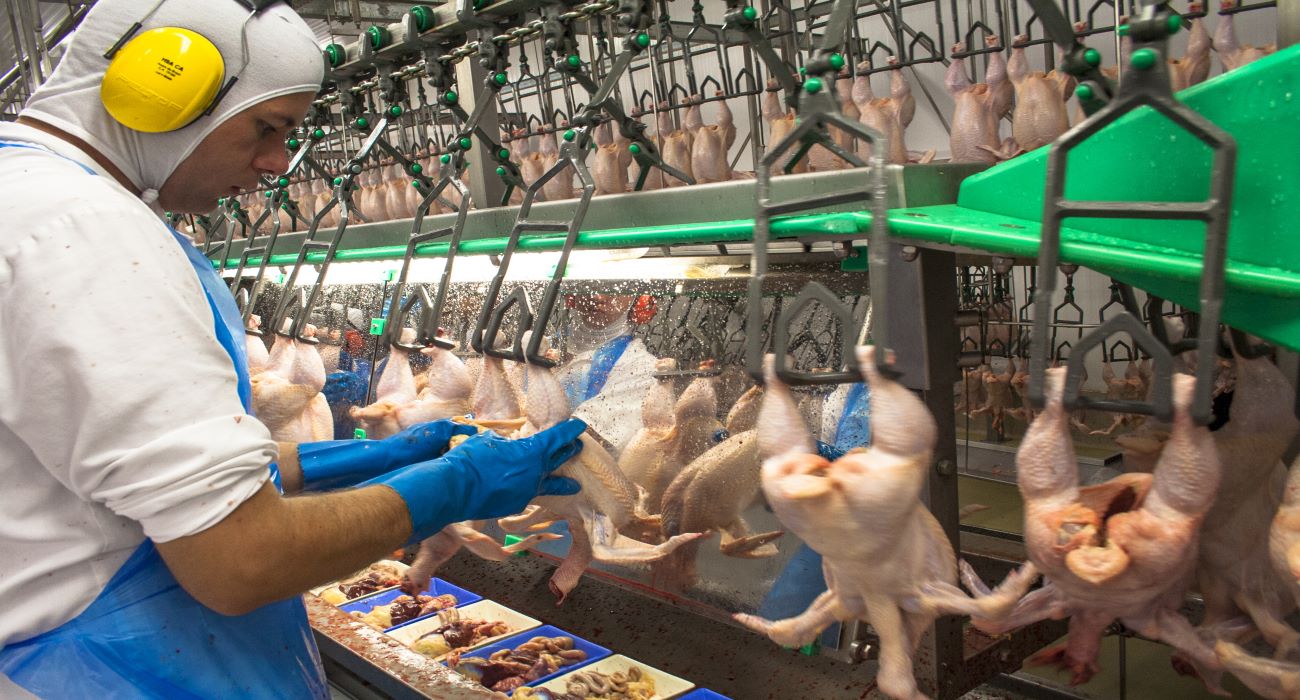
©Shutterstock A chicken processing factory in Sao Jose, Brazil
This question may seem simple to answer for you – “Oh yes ban them so that our farmers can be rich!” But things are much more complicated than they may seem.
First of all, an outright ban on the importation of products from foreign countries can be viewed as a protectionist trade policy. What is protectionism? Protectionism simply refers to government policies put in place to limit the importation of goods into a country to protect certain industries of the import-competing sectors in that country from foreign competition. In our case, what a protectionist policy such as banning the import of frozen chicken seeks to achieve is to protect local farmers and workers from losing their source of income or even in some cases increase their incomes.
Before we even think of banning the import of chicken into Ghana, let us first examine some possible reasons why Ghanaian consumers prefer imported chicken.
Perhaps, Ghanaian-reared broilers are more expensive than their imported counterparts but per that logic, wouldn’t you think Ghanaians farmers should purchase locally hatched day-old chicks over foreign ones since they (local day-old chicks) are much cheaper than those from abroad?
Let’s analyze this scenario. You need to withdraw money from a bank to purchase some household items and you have two accounts with different banks. One of the banks has enough cash in it reserves to allow you to withdraw money in bulk so that in one day you could purchase some soaps, cutlery set, kitchen utensils, and perhaps some foodstuffs all at once. On the other hand, the other bank only allows you to withdraw money once every month for 5 months, the same money you could have withdrawn in the aforementioned bank at a go – this means you can buy foodstuffs in the first month then the following month you buy utensils, then another month you buy soap. Like WTF! Do I have to wait three months before I can properly take my bath? I’m pretty sure you’d close the second account because you’ll consider it useless. This scenario can be likened to Ghana’s broiler industry. Production of broilers in Ghana is so insufficient that it barely scratches the surface of the demand.
I believe that Ghanaian broiler farmers must invest more in marketing as customer purchasing behaviour is not always dependent on pricing as was clearly illustrated by the day-old chick case study. Furthermore, any attempt to abruptly ban imports will lead to abnormally high demand and low supply which would be great for the farmers but disastrous for the consumers. The best way we can ramp up local production is through lower taxation to incentivize larger-scale operations and also, by helping farmers gain access to cheap credit (government interventions).
In short, I believe it is a bad idea to ban the importation of frozen chicken into the country. Before we even think of such a drastic measure we must first fix the underlying problems; one being the lack of proper marketing for Ghanaian chicken and the other being low production capacity.
 Pkom
Pkom 
Well said Mensah…I’ll go straight to the point. Of course the demand of broiler meat may not be met as you say, also making available of resources needed for a fast brood and quick maturity of broiler birds maybe expensive or cannot be reach by local farmers. But I point it to you that, 90% of the broiler meat that comes from other country are as good as roughages(cannot meet the purpose in which they were bought). Nutritional value drops to 10%, chemical preserved meat & prone to disease. I’m talking to you from a study I did. For me I choose to buy a broiler meat for an higher value that meets all the necessary requirements, than imported meat for a lesser amount for the following aforementioned reasons.
Solomon – Nigeria 🇳🇬
LikeLike
Interesting take.
LikeLike